Mediterranean Garden Society
Mediterranean Garden Society
About the MGS
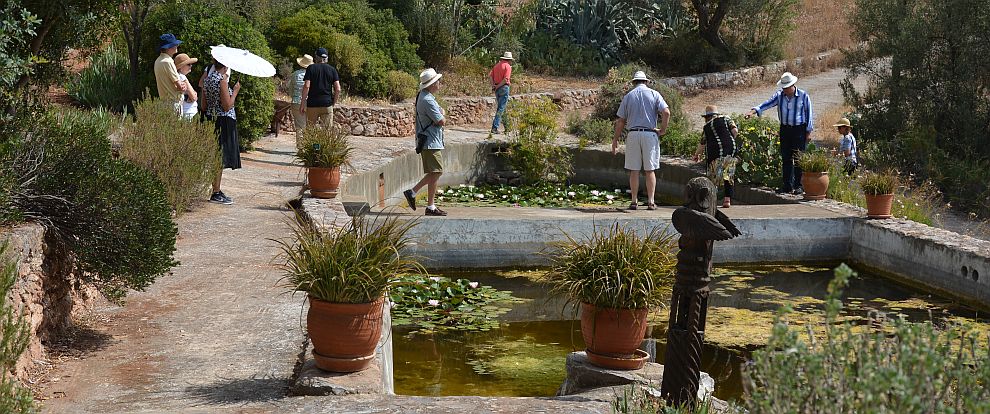
The photograph at the top of this page shows a group of MGS members visiting Sparoza Garden (Photo Rosey Boehm)
History
In 1994 a small group of gardeners in Greece who were struggling with their gardens had the idea of founding an association dedicated to mediterranean-climate gardening. They realised that it was useless for those in summer-dry climates to follow existing gardening models from Northern Europe where summers are mild and rainfall plentiful.
At that time there was little information available about what mediterranean-climate gardening entailed. Their goal was to develop attractive alternative gardens working with, rather than against, the natural climate and conditions. Plants native to mediterranean-climate regions are by their nature adapted to resist drought. Water is a precious resource and waterwise gardening became by necessity a founding principle.
The late Sally Razelou, founder President and Custodian of Sparoza wrote in The Mediterranean Garden No. 99 about its beginnings.
The mediterranean climate - broadly defined by rainy winters and hot, dry summers where drought can last for up to four, five or six months - is shared by the countries surrounding the Mediterranean Sea as well as areas in California, Australia, Chile and South Africa. Thus it was inevitable that those pioneers in Greece would reach out to other gardeners in these areas to share information, plants and resources.
Today
The Mediterranean Garden Society is a non-profit-making association founded in Greece with members in 38 countries.
English is the working language of the Society but we also operate websites in four other languages French, Greek, Italian, and Spanish. Our websites are a unique, one-stop source of all information and dialogue relating to mediterranean-climate gardening.
The Society publishes a quarterly journal available in paper or electronic format which includes articles written by members from all over the world as well as the beautiful line drawings that make the journal so distinctive.
We organise two to three international garden tours a year for members, often with a special topic in mind such as wild flowers or to explore a far-flung part of the world.
Local branches in several countries plan their own activities ranging from lectures and demonstrations to garden visits and expeditions to areas of floral interest. Facebook encourages interaction between our members both locally and across the world and many Branches have their own pages as well as branch websites.
The society runs Sparoza, an experimental garden outside Athens. It is an important example of one of the earliest private waterwise mediterranean gardens to be created and has one of the most significant collections of mediterranean plants in Greece.
The society is organised entirely on a volunteer basis both at the central and at the branch levels.
MGS Officers
President - Virginia Murray
Vice President - Robin McGrew
Secretary - Carolyn Mitsikostas
Treasurer - Jill Yakas
Councillor - Sophia Stathatou
Member Responsible for Communications - Jacqueline Potter
Journal Editor - Caroline Harbouri
Head Gardener - Lucinda Willan
Website Design and Management - Hereford Web Design
Past Presidents -
Sally Razelou,
Heidi Gildemeister, Katherine Greenberg, Cali Doxiadis, Caroline Harbouri, Jean Vaché, Alisdair Aird, Caroline Davies, Bernhard Leibkutsch
Minutes of General Assemblies, AC Meetings and the Annual Financial Report are available to Members on request to the Secretary.
The MGS Charter, which sets out the aims of the Society, was first drawn up under Greek law in 1994. Amendments to the Charter which the AGM resolved upon in November 2022 have been approved by the Court and are in full effect. These modifications will enable the MGS to function better, to be more responsive to the goals of the membership, and to encourage more members to take more active roles in pursuing the Society’s aims. Members who would like to read an English translation of the revised MGS Charter can download it here, or who have any questions about the MGS, please get in touch with the Secretary.
Registered Office
Mediterranean Garden Society, PO Box 14, Glyka Nera, GR-15304 Greece
email address: mgssecretary@gmail.com
The Mediterranean Garden Society is registered as a non-profit company in Greece.
Company Registration Number: 19843/95
Tax number 998420629 - Registered at the Tax Office of Koropi, Attica, Greece.
THE MEDITERRANEAN GARDEN is the registered trademark of The Mediterranean Garden Society in the European Union, Australia, and the United States of America