
Mediterranean Garden Society
Mediterranean Garden Society

The Attica Branch of the MGS
The Attica Branch welcomes all gardeners and want-to be-gardeners of all ages and from all backgrounds. Our members are spread out across the region and range from people who have large designed gardens to those who live in the city and get creative on a tiny balcony. We regularly get together to visit gardens of interest, both private and public, visit local nurseries, hear talks by experts and participate in workshops. A couple of times a year we arrange a weekend away to other regions of this beautiful and fascinating country to explore and connect with members who are not resident in the Athens area. We try to offer a diverse range of activities to appeal to our broad membership.
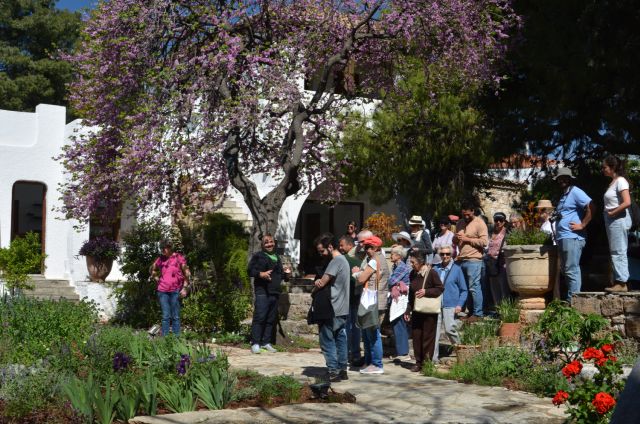
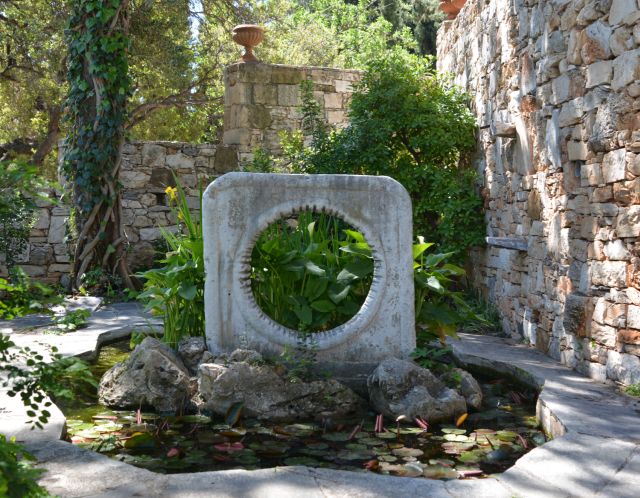
The Attica Branch is home to the wonderful garden of Sparoza, the centre of the MGS. Some of our members volunteer weekly (Thursday 10-12) to help take care of the garden. If you would like to join us contact Miranda, the volunteer coordinator, for more details.
Twice a year we host a seed and plant exchange at Sparoza. Members, their friends and family are invited to the garden to stock up on healthy plants propagated by the Head Gardener of Sparoza, from seeds and cuttings from the garden. These events are held in the Spring and Autumn on dates that are posted on our website. We also invite our members to get together at two relaxed dinners/lunches at Sparoza - one just before the Christmas holidays and one before our long summer recess.
Our Branch is ably and enthusiastically supported by a committee comprising Villy Loumaki and Thalassini Karali (biographies). To find out more about the activities of the Attica Branch, current and prospective members are welcome to contact them by email.
The photograph at the top of this page shows an olive grove in spring carpeted with wild Anemone coronaria. We are lucky that here in Greece not all the natural flora has been destroyed by intensive farming.

Ελληνικό ιστότοπος του MGS
Past Events
April 2026 - Athens
Ophrys Hunt at NTUA

A wonderful day at the NTUA campus in Athens looking for orchids organised by Thalassini Karali and the MGS Attica branch.

These are some of the many different orchids we saw:


Thank you for the hospitality, Alexios Vardakis and Thanasis Ziros and for inviting us and a big thank you to everyone who joined us.
March 2026 - Corinth
Ancient Harbour at Lechaio and Acrocorinth

Local plant expert Isabel Sanders guided us on a spectacular excursion to Korinthos for the wild flora of Greece and ancient sites. Our first stop was the ancient Roman harbour and basilica at Lechaion, where we carefully watched for birds nesting in the seasonal lagoons.

Situated where the Peloponnese meets Attica, the harbour was a connective hub and the hill, fortified for well over two millennia, protected the thriving city of Corinth.

The geographical position and variety of habitats make both sites incredibly floristically rich and supportive of several rare and endemic plants and animals.

Afterwards we drove up the hill of Acrocorinth, stopping along the road to take in views and look at some interesting bits of bedrock.
Volunteering at Sparoza - January 2026

On 11 January, we had our first Sunday volunteering session of the year at the garden. On these days, members are also welcome to visit and enjoy the garden alongside the volunteers. We ask people to let us know in advance so we can estimate numbers and prepare accordingly.

It was a beautiful, sunny day and a lovely opportunity to meet both old and new friends of the Society, work together, and spend time in the garden.

On this occasion, we also shared a traditional Greek New Year’s cake, the vasilopita. It is a custom at the beginning of the year, symbolising good fortune, with a hidden coin inside. The person who finds it is considered the “lucky one” for the year. It felt especially nice to include this tradition during our first gathering of the year.
Volunteering at Sparoza - Autumn 2025

Volunteering at Sparoza, which is open only to members, has become a very happy and much-anticipated time for many. We held 14 volunteering sessions the previous three months and, in addition to the regular Thursday sessions, we added one Sunday each month.

During these volunteering days, members from all over the world visited the garden, enjoyed guided tours, and then met with the volunteers. This has truly become one of the highlights of our branch’s activities. We welcomed members from the USA, UK, Greece, Australia, France, and Italy.


Catalogue of the MGS Library

Finally, Sasha Korellis, a new member and an artist, has found a simple and effective way for us to begin cataloguing the remarkable MGS library. It felt only fitting that the first book to be catalogued was Jacky Tyrwhitt’s Making a Garden on a Greek Hillside.
January 2026 - Ilion
Visit to Pyrgos Vasilissis

We enjoyed a visit to Pyrgos Vasilissis (the Queen’s Tower), where we explored the olive grove, vineyard, gardens, and stables.

We finished the visit with a wine tasting.

Visits in Autumn 2025

We visited the Diomedes Botanical Garden and had a wonderful time, with Antonis and Nikos, the new agronomists of the garden, giving us an inspiring and informative tour in November.

We also visited the Duncan Dance Research Centre, where we learned about the work of two artists, Garance Maurer and Annalisa Zenga, who were residents at Duncan for the Match.eu project in October.
In addition, we attended the Greek Mountains Conference at the British School, co-organised by our member Maria Christodoulou in October.

As a group, we visited the Seagarden exhibition at EMST, where Catriona Gallagher created an installation using Jacky’s slides, Sally’s phone catalogues, and her pressed flowers (November and December). “Tools for Cataloguing a Dry Garden” (2025) installation, connects her work to the Sparoza garden, using plant imprints and materials from the garden itself to produce her 16mm film. The natural environment becomes a collaborator in the work, actively shaping the image and the viewer’s experience.
Workshops at Sparoza in Autumn 2025

Our botanical workshops have brought together a lovely group of members. Jennie and Seyran are the hosting artists and so far they’ve held two sessions, one in November and one in December.

May and June 2025 - Kifissia
ANTHOGRAPHIA Exhibition

A fascinating Exhibition at the National Museum of Natural History Goulandris in Athens, supported by MGS. Work was displayed by 16 contemporary artists from across Europe, alongside MGS Journal cover illustrations. Here is a report on the event.
June 2025
Summer Solstice Party at Sparoza
Our first Summer Solstice party at Sparoza was a warm and joyful evening shared with both new and familiar faces. Just before the party began, a brief and gentle rain refreshed the garden - a welcome gesture from nature.

We gathered to enjoy the day, the garden, and each other’s company. Thank you to everyone who came and helped - your presence made the evening so special.


We look forward to welcoming even more members to future events - stay tuned!
March 2025 - Sparoza
AGM group visit
We had the pleasure of welcoming a group of international MGS members to the garden on 31 March before they departed for their "Three Fingers" tour in the Peloponnese. It was a delightful gathering of friends from around the world, with many Attica members present.


(Photos by Paul Vincent Wiseman)
March 2025 - Sparoza
Plant-based film developing event
Catriona Gallagher, member of Attica Branch and one of Sparoza volunteers hosted a special plant-based film developing event at Sparoza on 23 March, using oxalis to create a natural developer. It was an inspiring day of experimentation and collaboration. We also soaked flowers and leaves we gathered from the garden in soda and vitamin c, laying them on strips of film and exposing them outdoors. While waiting, we shared lunch on the south terrace, reminiscent of the legendary Kathara Deftera gatherings hosted by the late Jacky Tyrwhitt in the 1980s. It was a truly memorable occasion.


Catriona Gallagher’s Film Project on Sparoza
Catriona Gallagher has been working on a film about Sparoza and its volunteers, exploring plant-based film processing techniques. Her research and creative work have been supported by Onassis Foundation through the Extended Research Residencies program. You can find more details about the project here.
March 2025 - Sparoza
Visit by the Friends of Goulandris Museum
A group of Friends of Goulandris Natural History Museum (GNHM) visited the garden on 16 March and enjoyed a tour by Lefteris and Lucie. Photos of this beautiful gathering can be seen on their instagram post.
March 2025 - Sparoza
Corfu visitors
This past winter there was enough rain in the garden, resulting in a magnificent display of spring bulbs and annuals in the garden that carried into the shrubberies, creating a colourful carpet of wildflowers. We welcomed a visit from the Corfu Branch on 10 March, followed by a garden tour led by Lefteris Dariotis. The group was thrilled to explore the garden and enjoyed a beautiful day together.


November 2024 - Koropi
Rose pruning workshop in the garden of Fleur Pavlidis

We met in Fleur's magnificent garden on a lovely autumn morning where Lucie led us on a wonderful adventure through the history of roses and then dived carefully into the art of pruning. It was a great day spent immersed in the glory of roses. I would like to thank both our generous host, Fleur as well as our rose specialist, Lucie.
November 2024 - Sparoza
Autumn Plant and Seed Exchange

We were lucky with the weather and after this vicious summer period grateful also for the gloriously rich variety of plants propagated by Lucie. Once the potted plants and the arrangement of the nursery display was completed it was indeed a rich and splendid array of Mediterranean plants. Many thanks to all those who visited and selected plants.

It is an aim of the MGS to encourage knowledge and planting of Mediterranean plants and this is an ideal opportunity. Many thanks to all who assisted so ably in making this another successful occasion.
October - Sparoza
The second ceramics workshop with Janet Lines

The second ceramics workshop with Janet Lines focused on the creation of beautiful stoneware pots for succulents and cacti. We looked at cacti and succulents, and pot displays at Sparoza to consider how the proportions of pots can help with growing particular plants and enhance the beauty of a display. It was a wonderfully creative occasion and I believe we all came away feeling very proud of our efforts.
June 2024 - Evia
Day Trip to Villa Kasteli and Paximadi
After six years we returned to the magnificent Villa Kasteli garden designed & planted by Jennie Gay. Following Villa Kasteli we then visited James Brown’s property at Paximadi nearby.

Lilian Lorenz, as our most gracious and generous host lead us through her wonderful garden and regaled the adventures since its inception.


The result is truly superb. I first saw the garden newly planted some five years ago and marvel at its success today. Top marks to Lilian and her team of helpers over the years in maintaining it and to Jennie for her initial design and planting.


I took away with me the importance of design, properly propagated plants, professional planting and for goodness sake some good soil and available water. On top of that there is the never ending hard work and nurturing by Lilian herself. It is an inspiring story. Thank you Lilian once again for sharing your garden with us.


From Karystos we drove to a seaside area Paximadi where James and Marie welcomed us their home beside the sea. James described the history behind his choice of location and pronounced it the windiest spot in Greece! It was a calm day on our visit. We learned of the close shave from the first wildfire and the devastation of the environs from a later fire.

James prefers a “wilderness” (my word) style of garden with trees and shrubs planted to blend in with and enhance the natural vegetation. It is most successful in creating a vista of natural vegetation from the elegant stone house down the slope all the way to the beach.
Thank you James for sharing with us your philosophy and the admirable results of your hard work and trailer loads of goat droppings!
It was a very pleasant and most rewarding day trip.
Text: Janet Harley
Photos: Lilian Lorenz
June 2024 - Sparoza
Janet Lines Ceramics Workshop
Sunday was a wonderful day with participants exploring working with clay to produce lidded pots and rain pots inspired by the forms and textures of summer at Sparoza.

Many thanks to Janet Lines for leading the workshop. It was a great success and we are already discussing further workshops with Janet scheduled for the autumn.
April 2024
MGS 30th Anniversary celebrations
Special thanks to organising committee for a wonderful programme celebrating the 30 years of the MGS. Saturday started with suspect weather but many members and visitors arrived at Sparoza to tour the garden in its late spring splendour.

Sparoza in late spring splendour
The evening “riff” session, an informal chat between Lucie and Lefteris Dariotis was both enjoyable and informative with plenty of free discussion from attendees. The musical soirée and supper following offered further opportunity for members and friends to get acquainted and swap gardening stories.


Sunday offered attendees a choice of two day trips: one to Mount Kithaironas scrambling hillsides searching for wild flowers endemic to the area


The highlight of this trip was definitely the vertical garden on an impressive cliff face above Porto Germeno which was decked with a myriad of plants nestling into every nook and cranny possible creating a tapestry of colour and pure delight.
The second trip was to the magical Delphi which was greatly enjoyed by those participating.
Katerina Georgi of the Peloponnese branch hosted a great couple of days the following weekend in Kardamyli. Saturday saw a beautiful luncheon at the Patrick Leigh Fermor Estate where members were free to walk amongst the gardens and view the magnificent homestead.
Katerina opened her glorious garden on Sunday morning to visitors and local members while also hosting a lovely collection of photos by a local photographer. A walk through the charming old Kardamyli was followed by a seaside taverna lunch. It was a lovely addition to the 30th anniversary. Here are photos and more details of the Peloponnese events.
Text: Janet Harley
Photos: Robin McGrew
January 2024 - Sparoza

We held the second Botanical Painting workshop with Matina Galati and it was a great success. The sun kept the cold at bay and we had a great group of people who all produced beautiful paintings of the Narcissus papyraceus and Anemone coronaria which are currently carpeting the garden.
October 2023 - Marathon
Gryllis Water Lilies visit
A happy band of Mediterranean garden enthusiasts visited the Gryllis Water Lilies spectacular venue.
Ioannis, his family and team continue to amaze us all with the creative expansion of the gardens.
After being welcomed along the inspiring Endless Spring Driveaway, we moved on to see the Japanese garden, Balinese teahouse and lotus pond, and the newly planted Mexican desert with magnificent towering cactus specimens.
Further along is the little Greek amphitheatre in the shade of the awesome oak tree, set amidst the freshly planted Mediterranean Garden. All praise to Stella who has achieved an inspiring result in a very short time albeit having planted in the heat of summer. Ioannis spoke about the irrigation philosophy & methodology behind both the positioning of the rocks as well as the selection and placement of the plants.
As has become custom Ka Despina served a gorgeous spread of homemade refreshments which were eagerly sampled by us all.
Take a look at the comprehensive website for the wide-ranging information available. Warmest thanks to the Gryllis family team for another wonderful visit. See you again in Spring Ioannis!
May 2023 - Sparoza
Thomas Doxiadis talks about his role in the Ellinikon Development, the largest coastal park in Europe
Thomas Doxiadis, architect and landscape architect of international recognition, spoke in depth about his involvement in the Ellinikon Project and the direction it will take over the years of construction. Watch the talk here:
The Experience Park - the first built segment of the Ellinikon project, the largest Urban Regeneration project in Europe - hosts in its total 75.000m2 more than 500 trees and 50.000 plants, 4 squares and 4 discrete green areas. The project highlights Reduce-Reuse-Recycle principle through preservation and reinterpretation. The notion of Symbiosis is to satisfy the needs of humans and nature for both to live in equilibrium. It offers a new paradigm of public spaces which represents Sustainability. The past of the site is celebrated, preserved and reintroduced through the lens of a new identity.
May 2023 - Kolonaki, Athens
Visit to Kitsiki Park
Kitsiki Park is a triumph of an inner city park managed and maintained solely by volunteers.
The initiative, begun in 2002 by Christina and her then assistant Vladimir, has grown into the most charming oasis in the midst of downtown Athens.

Since 2019 Alexis has become an integral part of the garden and together he and Christina have embarked on a concerted re-planting effort following the damage by snow some years earlier. With the addition of some large trees and brilliant swathes of bright red Salvia greggii, some box hedges to restrain dogs and little feet from trampling the plants, this is indeed a wonder to behold.

The birds and insects are delighted as are the local cats with their very own accommodation quarters.

Tirelessly and with little help or support beyond their own resources, Christina, her sons and Alexis present a modern marvel of cool and calm, where in summer months there are cinema showings in the playground & birthday parties for the young of the geitonia.


Our thanks to both Christina and Alexis for a wonderful morning in Kitsiki Park. Their generosity in heart and spirit is inspiring.
April 2023 - Sparoza
Botanical Workshop
Matina opened the workshop by introducing us to primary colours and techniques to mix and create our shades with varying intensity of light, brightness and warmth.

She proceeded to paint with such delicate brushstrokes the ready pencil sketch of an iris with all the inherent intricacies of the feathery petals and light and shade playing on the plant on a muted spring day. It was pure magic.

And then our turn came. We spread around the garden, each to our spot to try our hand.


Some did very well indeed. A great day was had by us all.
April 2023 - Sparoza
The Plant and Seed Exchange
We had a wonderful day for the Spring Plant & Seed Exchange where a steady stream of visitors attended with lots of rare and endemic plants being snatched up by eager hands and we achieved a record-breaking turnover. It was particularly pleasing to recognise the growing number of Greek gardeners visiting, showing interest and awareness of the plants native to our country. Thank you to all those who contributed to the success.


March 2023
Myths and Medicine Plant Walk in the National Garden, Athens
The National Garden as described by Henry Miller " is the quintessence of a park, the thing one feels sometimes looking at a canvas or dreaming of a place one would like to be in and never finds". We found ourselves there on a beautiful sunny Sunday on a tour with our delightfully informative guide Maria, The Greek Herbalist, learning about myths and medicines of the aromatic trees and plants of Greece.

January 2023
Benaki Phytopathological Institute in Kifisia
A group of us visited the Benaki Phytopathological Institute (BPI) for an inspiring day exploring the work of the BPI and the various different threats to Greek flora and agriculture.

The BPI was founded in 1929 and is at the forefront of scientific research into plant heath and protection and works closely with the Ministry of Rural Development and Food (MRDF).

We were treated to a fascinating range of talks from different department heads which included soils, bacteriology, the importance of insect pollinators, as well as separate discussions about weed science and mycology.

Dr Panagiotis Milonas gave us an overview of the work of the BPI

Dr Maria Holeva discussed the threat posed by Xylella fastidiosa to the horticultural and agricultural industries of the Mediterranean
We are so grateful to the staff of the Benaki Phytopathological Institute for the incredibly warm welcome and their generosity with their time and knowledge. We hope that it may lead to a partnership in the future.
Text and photos: Lucinda Willan
December 2022 - Sparoza
Christmas talk ‘Adventures with the mediterranean flora of Southwestern Australia’

Special thanks to our guest speaker Eleftherios Dariotis, who with his humour and endless knowledge, led us on a captivating botanical voyage of West Australian endemic flora.


The Sparoza homestead was resplendent with flowers from the garden displayed in handmade wooden vases gifted by our dear friend Máté.


And the wafting spicy aromas of mulled wine and Christmas treats.


A lovely evening was had by all. Our very best wishes to you all for the Festive Season.

Eleftherios Dariotis is Greece’s leading plantsman, botanist and a long-standing friend of the garden at Sparoza. Lefteris’ Christmas talk at Sparoza was the first in a new series of talks. Ένα βοτανικό ταξίδι στην Δυτική Αυστραλία, was in Greek and took us on a mind-bending journey through the spectacular flora of the region and his encounters with venomous snakes and giant lizards along the way.
June 2022
Full Moon party at Sparoza
After deafening threats of mid-summer thunder, calm returned without a single drop of rain, and the clouds dissipated allowing the magnificent moon to shine radiantly across the garden bathing the evening in golden light while a gentle breeze cooled the night.

The team of trusty volunteers prepared a great selection of dishes to accompany the array of roasted meats from the local taverna and several members also brought tasty contributions, including a beautiful full moon bread decorated accordingly.


Members were able to enjoy a glass or two of a delicious new season Malagouzia generously supplied by Kokotos Estate for which we are most appreciative. Our thanks to Anne for this kindness.


Special thanks to Lucie for the lovely setting decorated with numerous vases of garden flowers creating a festive atmosphere.

It was an opportunity to display the as yet unfinished memorial portrait of Sally still under the brush of Cherry Pickles.

We all enjoyed the evening as we met and mingled at the Sparoza Summer Full Moon Party under Sally’s benevolent gaze.

Text: Janet Harley Photographs: Catriona Gallagher
June 2022
Visit to Gryllis Waterlilies, Marathon
We always have such a good time at Gryllis Waterlilies and last week was no exception.
From the very first steps walking through the Endless Spring Driveway, we are captivated by the extraordinary display of plants each blending into another; the forms, the colours and textures and movement. It’s not to be missed in any season.

Gary, the donkey is a star, as are the exotic birds and colourful koi fish; the waterlilies superb during our visit blooming with such a range of colours and the butterfly display in the salvia quite enchanting.

The thematic approach to developing the gardens into “small small worlds” of international flavour is really successful.

It’s exciting to tour through the Chinese and Japanese sections set around waterlily ponds, to follow the path to the pagoda fringed on one side by the bamboo forest and the bonsai-studded slope on the other. Shade will be provided by the splayed ligoustra.


On emerging from the dense bamboo forest, one sees the Balinese tea house soon to be surrounded by aquatic plants and exotic fish.


Behind the sizable expanse of the glasshouse propagation and nursery area, high on the hillside sits a Greek amphitheatre-shaped garden soon the planted with an eclectic range of indigenous plants along with the several 400-year-old olives already in place having been rescued from a major state highway project. Nearby on the same hillside stands a Mexican cactus grove waiting to be planted in autumn.

Ioannis, while providing a shady refuge from the summer heat & a cool drink, gave us a descriptive explanation of green roof gardening techniques and aquatic plantings before we were bewitched once again by the magic of his mother’s home-cooking. Our sincere thanks to Ioannis, Ka Despina and Litsa for their wonderful hospitality.

I had promised myself I wouldn’t make any purchases as the summer is already too advanced for new plantings but I simply couldn’t resist a couple of succulents for my garden in Syros … they’ll cope, don’t you think?

Text and photos: Janet Harley
May 2022 - Visit to Calme Garden, Rothon, Athens
Last Saturday we visited Calme Gardens on a beautiful warm and calm evening.
This visit was described by one member as “a really full enriching experience; an uplifting break from the everyday routine or usual ways of entertainment”.
And indeed it was.
Calme Garden is an eco-cultural educational centre based on regenerative practices, that functions within a shared economy framework of goods and experiences between people of all ages.

Our delightful host Costas welcomed us at the front gate and took us on a gentle and informative tour of the gardens beginning with the vegetable patch where we experimented with the variety of plants and scents in the garden. He explained the path their approach has taken in permaculture. A description was given of the principles and practices of cultivation such as keeping seed from the plants in situ for the next crop.

We met the beautiful little Skyrian horses which are often allowed to graze freely in the garden they fertilise so generously.

Simone introduced us to her fragrant varieties of kombucha such as both green and black oregano, rosemary, black lavender, green and black chamomile; all were delicious, my favourite being αρμπαρόριζα (pelargonium graveolens).

Another refreshment offered was water kefir which was a first for all of us and very refreshing.

Costas spoke of the history behind Calme Gardens, referring to the philosophy followed from the international organisation, Evolving Cycles.

Tatiana is to be congratulated on the superb buffet she prepared using produce from the garden.
Kale chips were a great success as was the delicious squash & ginger soup … but I’ll end up listing all the dishes as each was as delicious as the next.

The photo shows the true colour of the tasty sensations.

Costas and Tatiana presented a very sweet bouquet of fragrant herbs to each of us as we made our farewells under a full moon after a heart-lifting evening in the calm of Calme Gardens.
Our warmest thanks to Costas, Simone and Tatiana.

Text by Janet Harley with notes from Alexios Vardakis
Photos by Janet and Katerina Merk
April 2022 - Sparoza
Seed and Plant Exchange
A superb day in Attica last Saturday saw the revival of the Seed and Plant Exchange after the hiatus brought about by Covid and the extended lockdown.


A poignant occasion where Sally was fondly remembered by all, especially members visiting the garden for the first time since her passing. Her spirit was with us all on this truly splendid day.


The garden was glorious, bathed in sunshine and alive with members and friends wandering admiringly along the paths linking the exquisitely groomed gardens. Lucie, supported by Máté and the trusty team of volunteers, has worked tirelessly and enthusiastically to bring the garden into its own splendour.


While Lucie was present to advise members choosing from ready potted plants, labelled and meticulously displayed in the re-vamped Nursery outside, Máté manned the table inside offering invaluable guidance to those choosing from the wide selection of seeds.


Special thanks are due to Christa on the welcome desk, to Vina supporting Lucie in the nursery, Sue and Frosso making sure all guests were supplied with refreshments, Catriona for the lovely photos, and Ioannis Gryllis for the tray of Helichrysum italicum kindly offered as take-home gifts.


Thank you to all members and friends who were able to visit and donated so generously.
Text by Janet Harley, photos by Catriona Gallagher
January 2020
Environmental Groups Get Together to Plant Trees and Learn about Sustainability, Kouvaras
MGS members, together with volunteers from Let’s Do It Greece and the Women’s International Group South (WIGS) enjoyed a wonderful day at the house of David Davis, engineer and inventor. Helios Eco Lab in Kouvaras is about 45 minutes from the centre of Athens. For details of the sustainable house project see (below) the write up of MGS Greece branch visit in March 2019.


Anastasia Ioannidis, local representative of Let’s Do It Greece told us about the origins of this group and advised that this year’s campaign is called “The Roots that Bind Us” which is to encourage the planting of trees up and down the country. For the day’s event, eight trees had been purchased by the sponsoring groups: three carobs and five fruit trees, as a token of support for the campaign. Everybody took up a sapling or a spade or a watering can and dispersed around the garden for the planting session.

With this task successfully completed, we all (now about 60 people) returned to the house for a presentation by David which covered his origins as an engineer and inventor, his desire to use only sustainable ways of living including powering the house and electric cars/bikes from solar PV panels, water and space heating with solar thermal energy, harvesting rainwater, growing his own food, recycling materials and batteries and much more.


Lunch followed (dishes having been provided by the participants) then some people stayed on to go on mountain walks and bike rides in the beautiful countryside.
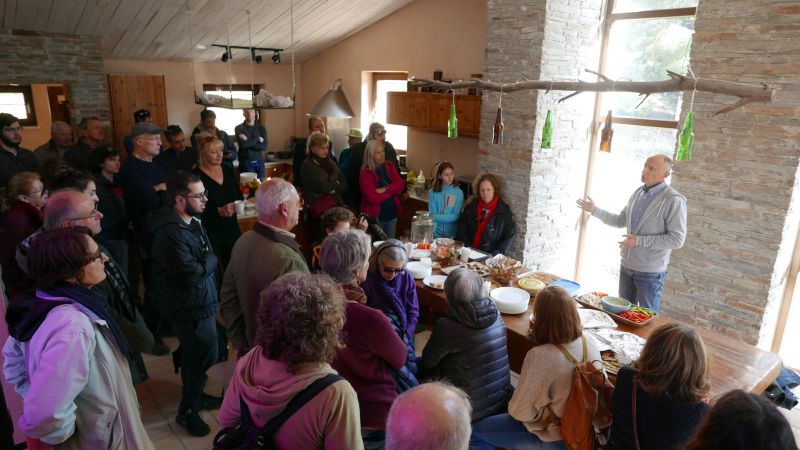
Let’s Do It Greece began as a teachers’ initiative in schools in the Athens suburb of Glyfada. Pupils were encouraged to do volunteering work through environmental groups. By 2019 the annual activity had reached 119,000 volunteers. The pan-Hellenic volunteer campaign Let’s Do It Greece for 2020 will take place on Sunday 10 March.

Women’s International Group South (WIGS) is an informal group whose aim is to provide a social milieu to build friendships and support group members for English-speaking women of all nationalities who reside in areas located in the southern part of Attica, Greece. The group’s volunteer work is related to social networking and supporting local community charities.
Text - Jeannette Arduino
Photos - Rosey Boehm
November 2019
Visit to Gryllis Water lilies, Marathonas
On a clear, bright morning about 30 MGS members with family and friends met at Ioannis Gryllis’ amazing nursery near the historic town of Marathonas, outside Athens. Over delicious doughnuts and chocolate croissants, tea and coffee served by Ioannis’ mother and sister he gave us a talk about green walls and roofs.
In cities there is limited space for greening the city with all the advantages that brings - helping with keeping cities warmer/cooler as needed lessening the need for air-conditioning; making an impact on noise and air pollution and all the psychological advantages that being able to see and experience plants gives us, using the walls and roofs makes sense. Of course, there are difficulties in doing this but it is all possible.

On the wall of the room there was a vertical wall planted less than 12 months ago and receives no direct sunlight. The plants that have been used for this planting include tradescantia, bromeliads, saxifraga and air-plants mounted on wood, and as is always the case it has to be “right plant/right place”. They are planted in pockets created in a special geotextile that is strong enough to hold the weight of the plants as they grow and to enable the plants to establish a root system. Ioannis pointed out that it is important to consider this when planting a green wall as there have been many occasions when the whole planting has ended up on the ground. Irrigation is from the top of the planting and trickles down. It is irrigated for a few minutes twice a day. The water could be collected in a channel at the bottom and recycled. There are other systems using pots which need to be attached to a frame in which bigger plants can be grown. Drainage and irrigation are always of prime importance.
We then moved onto green roofs. At the nursery there is a green roof planted largely with sedums as it is a relatively small structure, actually it’s a dog kennel!

The depth of the soil is only 10cms which is about the minimum required to create a garden. The sedums planted here can withstand the full sun they receive in this position. Once again drainage for the plants and protection of the roof are of prime importance and Ioannis suggested that unless you really know what you are doing it is a good idea to employ the knowledge of an expert. We also saw plantings on a number of shipping containers on site. These are in a soil depth of about 12cm and the plants include a number of grasses and salvias which are doing well.


We then spent quite some time walking around the nursery admiring the koi fish, the water lily ponds, the work done on the “European garden” and the mediterranean sections with I am sure each of us drawing up a mental “wish-list” for all the plants we would like. We finished this amazing and interesting visit with a wonderful lunch given by Ioannis family for which we would all like to say a big “thank you.”


March 2019
Visit to David Davis’s house, Attica
About 25 members of the Greek Branch visited the house of David Davis outside Markopoulo in the Attica region of mainland Greece close to the Athens international airport. The house is situated in some of the last remaining pine forests in the Attica region. David bought the land on which the house stands in 2003 and since then the house and the land surrounding it have become his on-going project. His aim is to create a system which illustrates that it is absolutely possible to create house that is off-grid and makes use of what nature provides to live a life that is affordable and comfortable. His question is: can we live with nature in a more sustainable and successful way?

We began the visit at the front of the house with David telling us about the green roof. It is set up as an interlocking box system. They are filled with soil and climate-suitable plants. During the first summer they were watered to give them a chance to get established but have received no additional water since. Being in boxes means that should one fail, for whatever reason, it can easily be removed and replanted.

Outside the front gate is an electric car charging station. David himself has only an electric car and bike which he says are more than enough for his needs. He aims to introduce electric cars into the Greek system. This presents some problems, of course. In Greece there are hardly any charging stations and virtually none outside the Athens area. Most are run from the main electrical system which burns fossil fuels. He encouraged us to believe that we can live comfortably off-grid: this absolutely is possible and at a relatively small cost especially in a country like Greece with our wonderful climate.

Someone commented that electric cars are still relatively expensive. David pointed out that as there is only one moving part in an electric car (except for the wheels) servicing costs are virtually nil. Almost all the journeys we make in our lives are within a radius of about 50 km and so the range of the electric car more than covers most of our needs. When asked how long it takes to charge an electric car, he said we were, naturally, thinking like petrol people. With an electric car you do not stop to fill it up - you top it up when you are not using it and, therefore, it takes no time. David harvests all his electricity from the sun and we went to look at the 54 solar voltaic panels on the roof and the battery room.

The inside of the house is made almost entirely of reclaimed materials - from the steel and wood that make up the staircase to a magnificent two-storey cupboard which is made of old wooden doors and shutters and looks fantastic. Many of the ceilings are made from recycled pallet wood. It is, David told us, a much more interesting way to create a house than the usual way of employing people to get everything up and ready as quickly as possible.

There is enough storage under the house for 30,000 litres of harvested water. The space for this was dug out when the land was being prepared for the house and it is insulated with 600mm of waste building materials. Water is pumped up from the water storage under the house to two 2,500 litre tanks at the top of the property and this is used to irrigate the garden with a gravity feed system. David said that this winter, because we have had an unusual amount of rain, he could easily have done with another couple of tanks of this size.

There is a pool which also stores water and for most of the year is a home for mosquito-eating fish and frogs but, for the three summer months, is a more conventional swimming pool (the wildlife gets re-homed for this time). Grey water from the house is directed on to the land. There is an Aquatron system for dealing with the human waste produced at the house. This is a centrifuge system in which the solids and liquids are separated. The solids fall into one of four compartments in a big drum and composting worms are added. Every three months the drum is turned so that all four compartments are used over the space of a year. It takes 3 -4 months for the waste to be turned into beautiful compost ready for the garden.

In the main control room of the house, which is an impressive place full of pipes, wires and equipment, there are additional systems set up in the house for heating under floor pipes connected to heat pumps. For three years this has been an air source heat pump but David has recently installed a water source heat pump which is more energy efficient.

Despite all the amazing systems in place in this house David finished the visit by saying that the best systems that you can use to make your living space as eco-friendly as possible are passive systems. If you are lucky enough to be building from scratch then consider all aspects of these systems - the orientation of the house to make the best possible use of the sun, insulation, window positioning, water harvesting methods and so on. As for gadgets, he says, use as few as possible for the best effect. His Facebook page gives more details of the technology.
November 2018
Visit to Evia
We all met up at the port of Rafina outside Athens and crossed by ferry to the southernmost part of the island of Evia - the second largest island in Greece. We were lucky that the weather was perfect for us as recently we have been having some cold and rainy days. From the port of Marmari we drove up to Lilian Lorenz’s property on the mountainside behind the seaside town of Karistos, and took in the spectacular view from her new house.
Lilian gave us an introductory talk about the planning and work that has gone into building and landscaping their new house and its surroundings.

The house is as eco-friendly as it could be within the restrictions of the law. The house has geothermal heating and large water-storage facilities. The driveway has been constructed to enable the collection of water and the watering of the beds in this area of the garden.

We were then given a talk by Jennifer Gay, who has designed the planting of the garden and was in the process, with her team, of planting.


She told us about the challenges of this particular garden, one of which is that it has to complete with not just one, but two spectacular views: one over the sea and another over the Kokkino Kastro - a large castle ruin to the southeast of the property.


The weather is challenging in the garden with a huge variety of temperature even over the course of a day and very strong winds.

After we had been told about the concepts and planting for the four distinct areas of the garden we walked round with Jennifer and she answered questions from our members.

All too soon we had to move on and were led by MGS member James Brown to his very different property and garden next to the sea outside Karystos. He told us about the design and construction of his house and the challenges of planting things in his garden which is subject to extremely strong winds for much of the year.
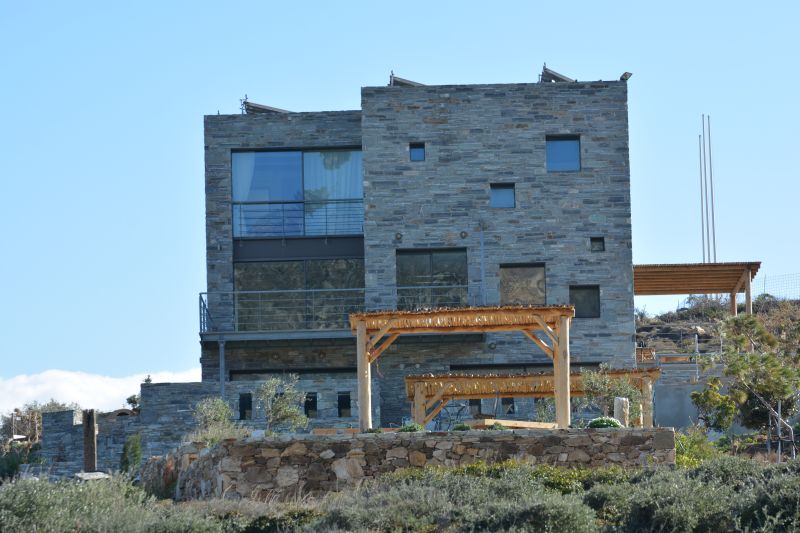
The garden was completely destroyed by fire two years ago and he is in the process of replanting and he is planting trees in the surrounding landscape and trying to encourage others to do the same. We walked around the property and onto the beach with James pointing out plants and things of note.

After all this fresh air we sat down to a welcome lunch of delicious Greek fish soup in a local taverna.
The MGS members on this visit would like to extend our thanks to Lilian, James Jennifer and Piers for their very interesting talks and for their generosity with their time, knowledge and enthusiasm.
December 2018
Visit to Ktima Kokotos Winery
The morning was crisp and cold but the sun was warming when we met at Stamata just north of Athens for this visit to Ktima Kokotos Winery for a tour around the land and the permaculture vegetable garden. We were led by the designer of this garden: Alexandros Kostis.

He explained that at its essence permaculture is a design science, a systematic thinking and problem-solving process. It is also a strategy to deal with and find solutions to soil erosion and degradation, biodiversity, placement of infrastructure. Permaculture can be explained as an umbrella of techniques combining ancient, traditional and modern. It is important to observe the land; to notice the direction of the flow of water, the wind, sun and soil.
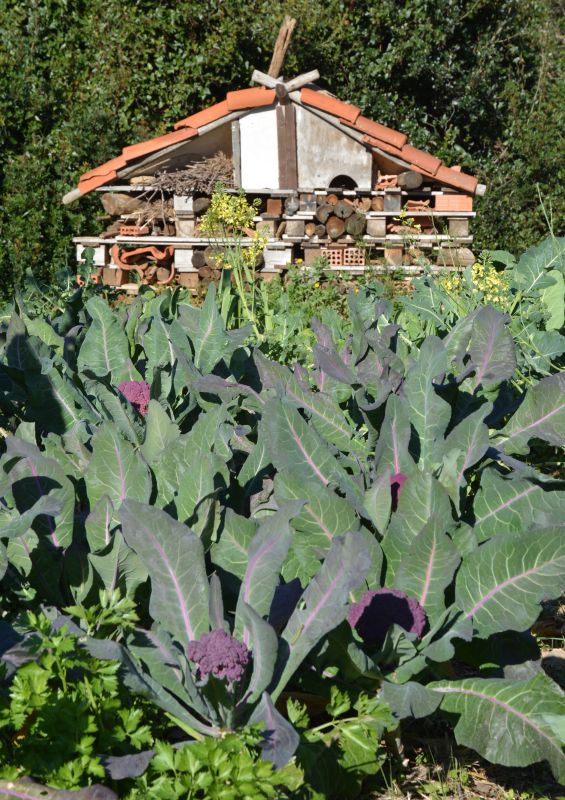
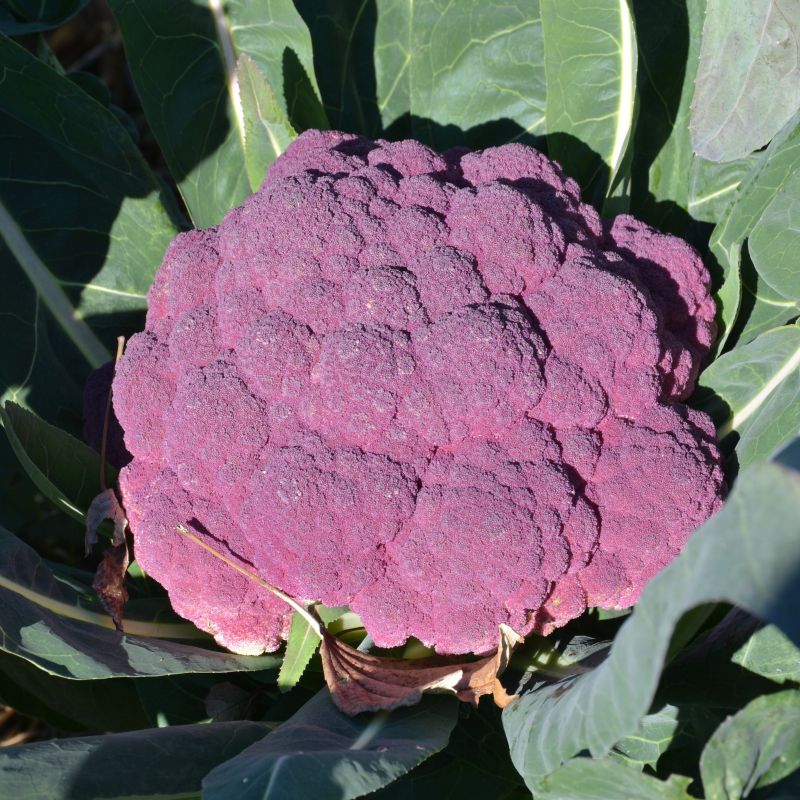
We learnt about the use of animals in the cycle of land use, the importance of taking the use and storage of water into consideration, the health of the soil, the vegetation and all the wildlife. He also told us something about the principles of design of eco-friendly houses. After meeting the ponies, we arrived at the vegetable garden started in August 2016 which has been set out in a circular design.
The family have a school here for children who spend a lot of their time learning about and interacting with nature and the design of the garden has taken all this into consideration.

Following this we were shown the vineyards by Anne Kokotas and she talked us through the wine-making process. The first wines were produced in 1980 and all the grapes on this estate are grown organically and they incorporate permaculture principles into the process, including the planting of green manures between the vines to fertilise them. Then we enjoyed a tasting of six wines that they produce, sitting at a beautiful wooden table with the sun warming us through the windows down one side of the building.
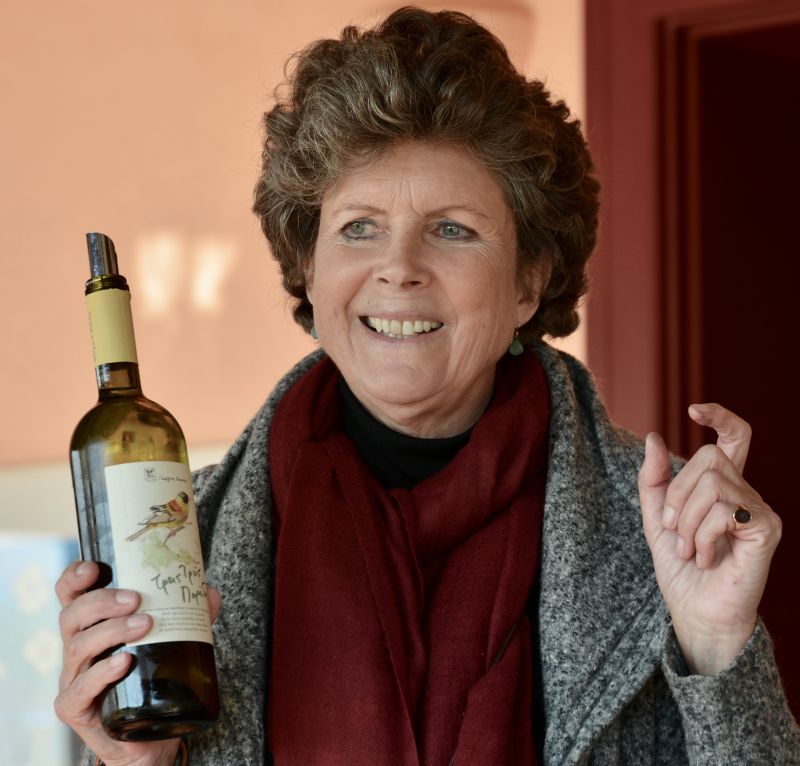

We left carrying wine and wonderful, freshly picked produce from the garden. Thank you to Alexandros and to Anne and all the family for such an interesting and enjoyable day.
Article and photos by Rosey Boehm
October 2018
Visit to the Pelion
In early October MGS members met in Volos, gateway to the Pelion, to a welcome of tsipouro and mezes arranged by our hostess Sue Wake of Lagou Raxi. Our first stop was the garden of Annie and Ioannis.

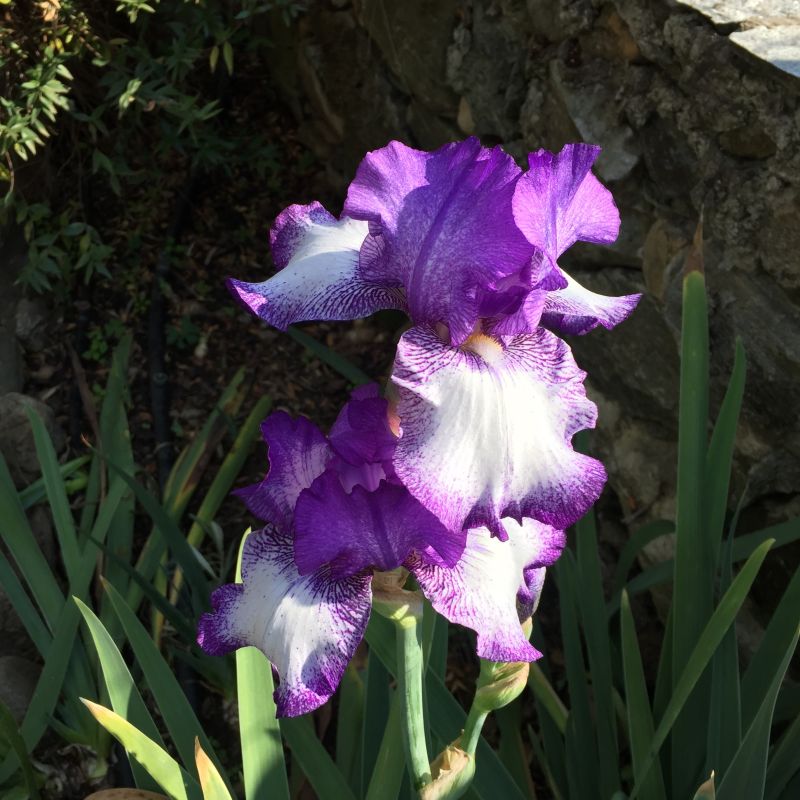
This mature garden is laid to lawn and set in an old Pelion olive grove: the lush grass had benefitted from the wet summer. Though pruned for ornament and to provide shade for the garden, the olive trees still provide a rich harvest. Planting was mainly in island beds with focal points of Phormium tenax, an occasional rocky outcrop, or precise topiary work, but it included mediterranean stalwarts such as Lavendula dentata, Rosmarinus officinalis, salvias, Tulbaghia violacaea and agapanthus. Those of us who were not iris experts were astonished by a beautiful Iris germanica hybrid blooming in the afternoon sun. Some were also surprised to see Gardenia jasminoides used as underplanting for olive trees close to the house, their double white flowers offset against dark green foliage.
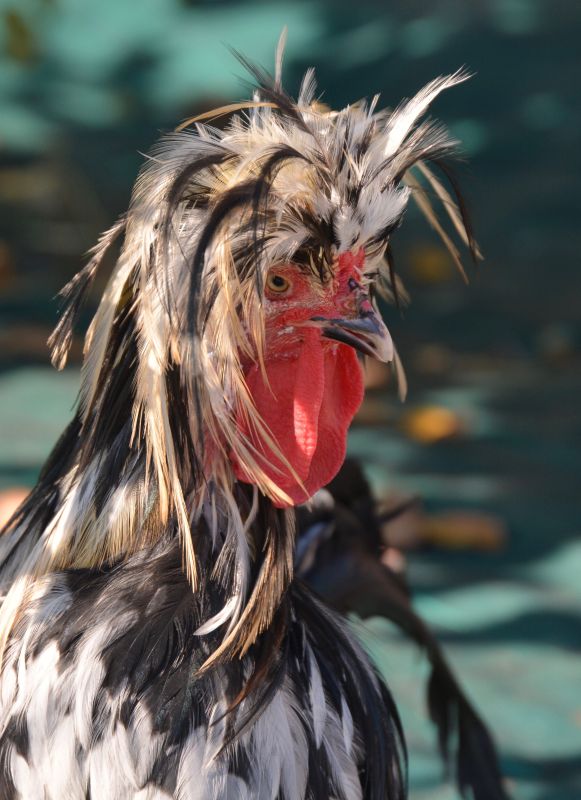
Rampant Plumbago auriculata and golden-yellow Lantana camara mask the boundary fence. A row of hybrid tea roses divides parking from a productive vegetable patch with raised beds protected from free-ranging chickens, all rare breed birds and an ornamental feature of the garden.
In the orchard we shared Ioannis’ despair over the condition of his Diospyros kaki but were full of admiration for his citrus trees which, though still young, were laden with fruit.
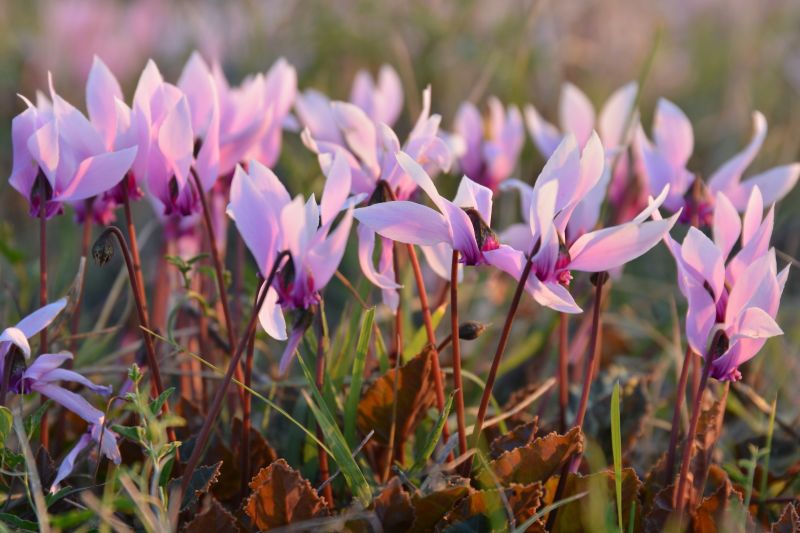
Continuing along the coastal plain we passed small garden centres bright with autumn chrysanthemums before heading up into the mountains and arriving at our hotel, Lagou Raxi, in time for sunset. A short orientation walk took us past banks of Cyclamen graecum before stopping to admire native grasses glittering in the last of the light on one of the many restored kalderimi of the South Pelion.
On a grey and windy first morning, we headed along the Trikeri coast road to the garden of designers Vida Chung and Vito. This visit was a delight and a source of inspiration for all. Steps down from the road took us past a small bed of cacti and succulents and across a small moss-covered courtyard at the back of the house before opening onto a series of east-facing terraces sheltered from the wind and ranged along the hillside above a small bay. The garden is accessed by small rough paths which zig-zag across the hillside. Shaded by old olive trees, succulents and cacti predominate, and repeat planting of Rosmarinus prostratus, Lavandula dentata and Teucrium fruticans cut into pleasing domes, along with simple ground covers such as Sedum spectabile, Aptenia cordifolia and tradescantia, combine to create a sense of unity and harmony.
The garden relies more on foliage and shades of green and grey than on flowers. The effect is enhanced by a series of natural “artworks” that sit organically in the land. A “basket” of woven cut branches cradles olive suckers which are trained and carefully pruned to fit.
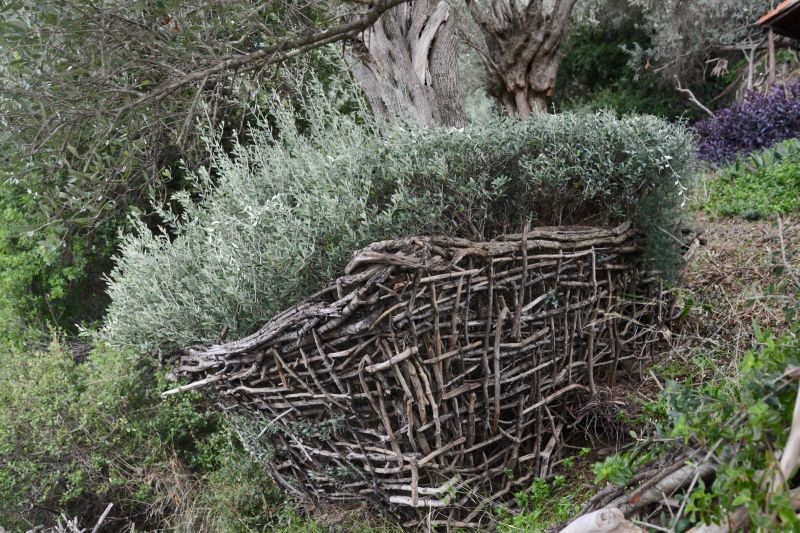
Large spheres rolled from olive debris are wrapped in wire and rope. Balconies are cased in woven driftwood.

A “tree house” guest bedroom is astonishing, sitting above a sea of olives, as is a separate kitchen with a massive oven serving an outdoor seating area.

The black wood finish of these buildings works beautifully with the greens and greys of the garden. Outdoor furniture and lighting are up-cycled, hand crafted and made with humour as well as style.
This is a very satisfying garden to visit, but not because of any sophisticated composition or the variety of its planting. It is a garden on a human scale, and one which you feel could be attained and managed by any of us if we had the ideas and originality of Vida and Vito.
We travelled on to Theotokou on the wild and storm-hit east coast where the sea had recently run right up to the remains of a beautiful tessellated monastery floor. We quickly moved to the less windswept bay at Kati Georgios beach for lunch before travelling south to our next garden.
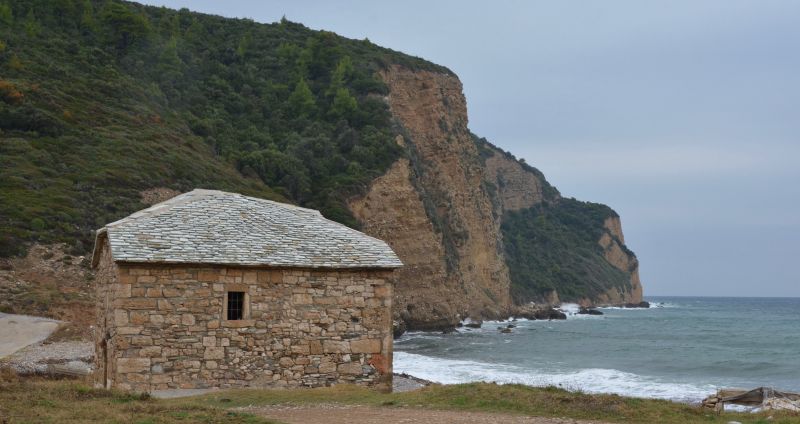
Looking towards Evia, the southwest facing coastal garden of Rudi Zelenka provided more food for thought. A long and vertiginous dirt road down through olive groves gave no indication of what to expect. In the parking area, our eyes were immediately caught by an Arbutus andrachne carefully pruned to make the most of the view. Down a steep path and under an arched gateway cut through the rock face, we entered a garden hugging the cliffs and arranged over a series of steep terraces down to the sea. Before the road was built, the house, most of which is hidden in the rock face, could be accessed only from the sea. Over a series of steep terraces Rudi has used topiary to carefully manage the vegetation and to create a strong and unifying structure. It includes good use of native coastal plants such as Arbutus unedo and andrachne, Rhamnus alaternus and Quercus coccifera and with banks of Rosmarinus officinalis and R. prostratus used to great effect along walkways and down staircases. Through this green canopy pop bushes of Tecoma capensis in the brightest orange, an exotic-looking large flowered pink mandevilla (probably), blue Plumbago auriculata alternating with Gaura lindheimeri ‘Siskyou Pink’ and a beautiful yellow Senna corymbosa.

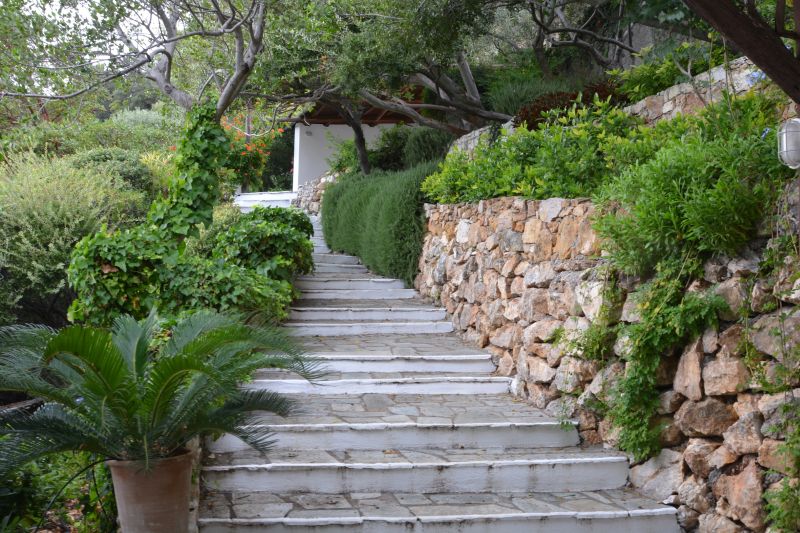
The weather did not dampen our spirits on Saturday. The group divided and while some walked the local kalderimi, others enjoyed an informative and companionable session on botanical painting led by the very talented Maggie Naigassas, a winner of an RHS Silver Gilt medal in 2018. The rest of the day was a full one, starting above Argolastis with a tour of the Pastisis organic vineyard and winery followed by a tasting of their excellent range of Pelion wines with family member Christos. We then travelled on to Paou Monastery, now a conference and cultural centre of the University of Thessaly. Here the priest, having forgiven us for our late arrival, permitted the group to enter St. Nicholas’ Church with its stunning frescoes and wall decorations. Lagou Raxi then laid on a splendid picnic lunch before we travelled on to the garden of Gereon and Karin, who we had met the previous evening when Gereon gave us an informative talk on grasses. A series of steep terraces lie immediately behind the house and more gentle terraces full of exotic fruit trees sit in front of the house, where there is also a series of ponds. The garden was full of fine exotic specimens including Bauhinia blakeana, Sophora japonica and Grevillea robusta. Gereon and Karin make good use of a shredder to mulch their collection.
I had to return to the UK so missed Sunday’s programme but I heard that the members were impressed by Doris Schlepper’s Serpentin garden and had a splendid time at the mushroom festival in Tsangarada.
You’ll be hearing more from MGS members around the Pelion in the coming year as we hope to set up our own small regional branch and we are also planning the post-AGM tour for 2019.
Article: Janet Ibbotson
Photographs: Rosey Boehm
October 2018
Trip to Pelion: A Short Introduction to Botanical Drawing and Painting
A change in the programme which turned out to be an unexpected and most enjoyable experience.
Upon meeting up in Volos, where the group gathered for mezedakia at a seafront tavern, we were introduced to Maggie Niagassas, botanical artist. The programmed “mushroom walk and foraging” had been cancelled and was to be replaced by an introduction to botanical drawing and painting.
Having not put paintbrush to paper since art classes at school (a long time ago, believe me) I was somewhat dubious about whether to join in or whether to go along with others who had decided to go for a walk instead. But since it was cold and rainy and we were promised coffee, I stayed for the art class.
Maggie led nine of us to the light and airy room she uses for her classes, where we sat around a large table already equipped with pencils, erasers and brushes. After a brief and very interesting introduction on the subject of botanical painting, and having had a look at some artwork and books, we were told to choose three leaves from a pile of foliage freshly picked.
With some general guidelines and advice from our instructor (who basically told us to relax and enjoy ourselves) we set about reproducing our leaves as best we could.
We were given some watercolour paints (two yellows and two blues) and left to mix up the greens we needed to match the colour of our subjects.
Finally, we had a look at each other’s work and were amazed to see so many different styles.
I thoroughly enjoyed this short session and would love to take more lessons. Hopefully Maggie will arrange a class in Athens one day soon.
N.B. I have only one complaint: I now cannot see an interesting looking leaf without wanting to draw it! I wonder if the other participants have the same problem?

Maggie gives week long courses in the spring and in the autumn at the Lagou Raxi Country Hotel. She explained that the courses were not all work but combined fun trips and visits along with some serious instruction. See her website at maggie-niagassas.com.
Article: Jeannette Arduino
Photo: Rosey Boehm
April 2018
Visits to gardens in Peania
This was our best-attended visit of the spring. About 35 members met up at one of Lefteris Dariotis’ gardens in Peania where we were given coffee and biscuits. In this particular garden he grows many salvias, bulbs and other plants too numerous to mention by name. He has recently created a bed of alpine plants with a mulch of fine gravel which is looking fabulous.

We then moved on to his ‘Goat Garden’. Here he has over 360 plants that are now grown with no water except for what they get from the sky. He started the garden four years ago. For the first year he watered the plants once every 10-20 days during the hot summer months. The second year he cut this down to every 20-30 days and for the last two years he has not watered these plants at all. The majority of the plants are native to Greece and the garden looked fantastic with many of them being in flower. He said that he has not added any compost or soil improver to the garden, but he has added a thin layer of gravel mulch on top. This garden generated much interest from all the members.
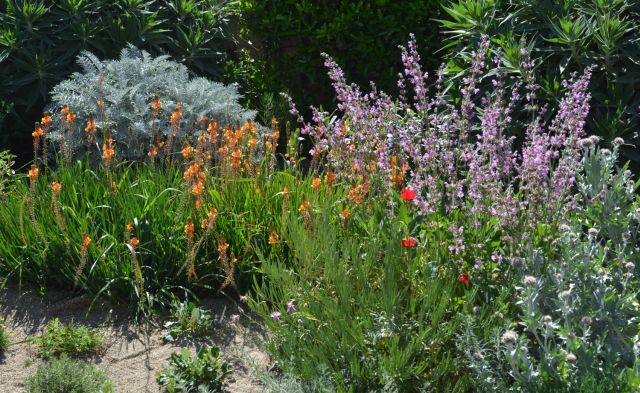

Finally, we visited the Vorres Museum where Lefteris has been involved in replanting some of the beds and pots with the aim of using less water. It was all looking wonderful, as always, and we were very interested to see the changes that have been made.
Committee Member - Thalassini Karali
Thalassini is an agronomist and instructor in horticulture and landscape architecture. She is an enthusiastic member of MGS and brings with her expertise in ‘kipotechnia’ the science of all things green.
Committee Member - Villy Loumaki
Villy is Greek and has lived and gardened in many places around Greece. She discovered the MGS through Heidi Gildemeister's book Gardening the Mediterranean Way and soon joined the volunteers at Sparoza, where she immediately fell in love with the garden. Her passion for learning more about Mediterranean plants led her to work alongside Lucie Willan last year, which she describes as a truly enriching experience.
For older reports and articles please check out the archived (non-responsive) Greek Branch page.
THE MEDITERRANEAN GARDEN is the registered trademark of The Mediterranean Garden Society in the European Union, Australia, and the United States of America