
Mediterranean Garden Society
Mediterranean Garden Society



The Andalucia Branch of the MGS
Andalucia is a huge area with some of the sunniest, hottest or driest, even windiest, parts of Europe which pose many challenges to gardening. Gardeners in Andalucia are an international lot from all parts of the world, working and caring for all sorts of gardens, large and small, from historic gardens with Moorish influences, large agricultural estates, to gardens of modern holiday homes.
Andalucia Branch Head is Sibylle Mattern: read her biography here. Members and prospective members please contact Sibylle with questions, ideas, suggestions.
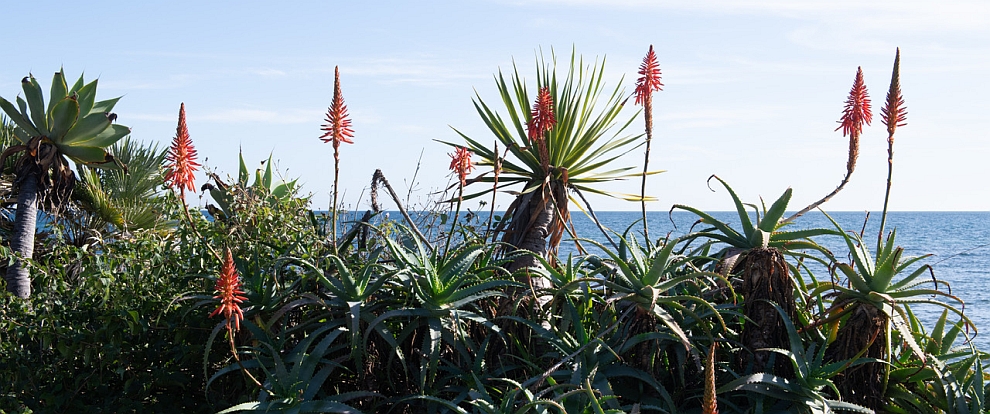
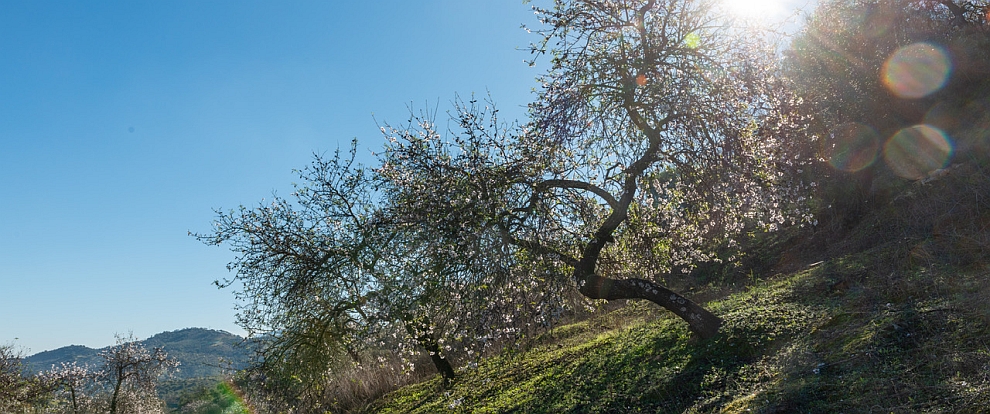
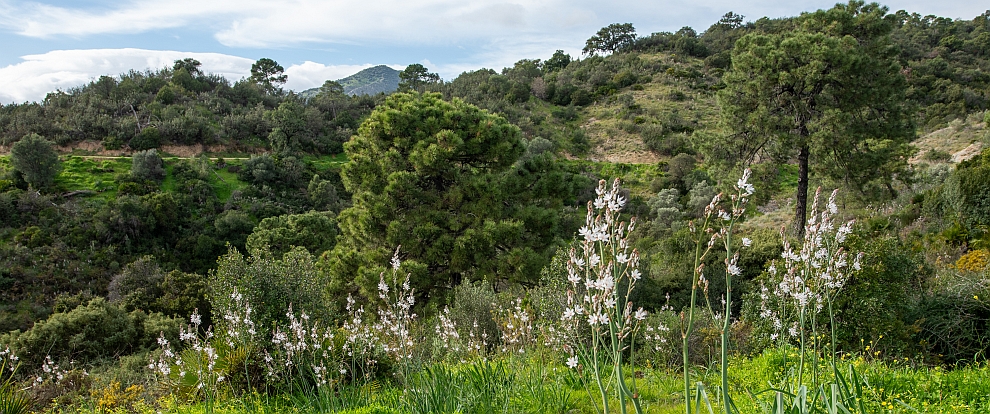
The photographs at the top of this page show views of Andalucia during winter: Landscape with cork oak; Plantings of aloe on the Mediterranean public coastal path, Marbella; View of the Alhambra, Granada; Almond tree blossom in February; Gardens of the Alcazar in Cordoba; Landscape with asphodels (Photos Sibylle Mattern)


Past Events
May 2026 - Córdoba
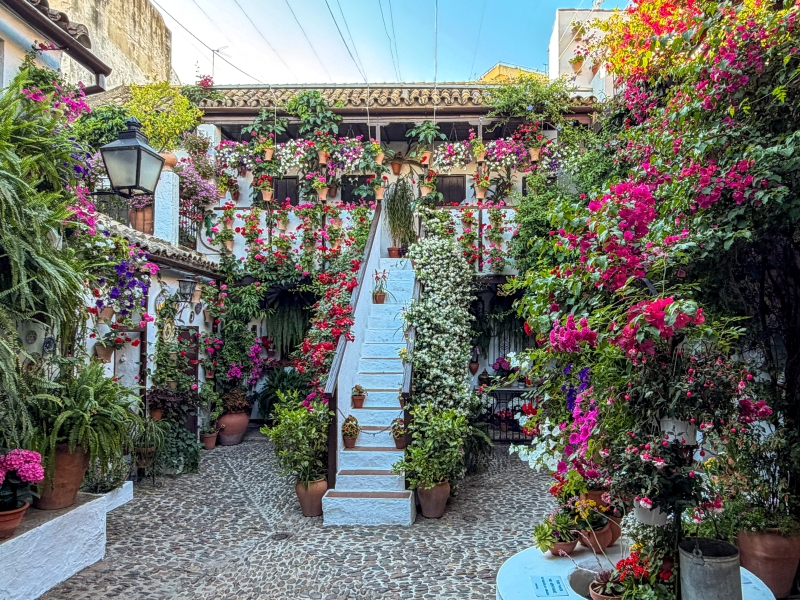
Exploring Cordoba´s historic patios with the MGS
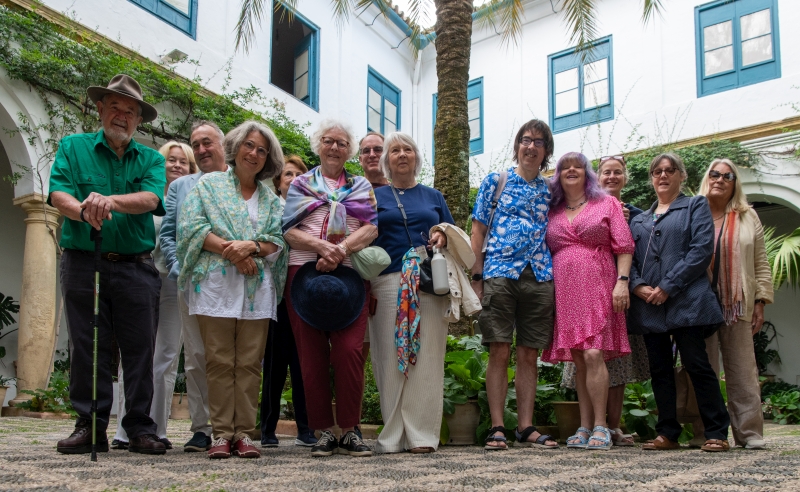
The Mediterranean Garden Society recently enjoyed a wonderful visit to the famous Festival de los Patios Cordobeses in Córdoba - and we were delighted to welcome three new members to the trip.
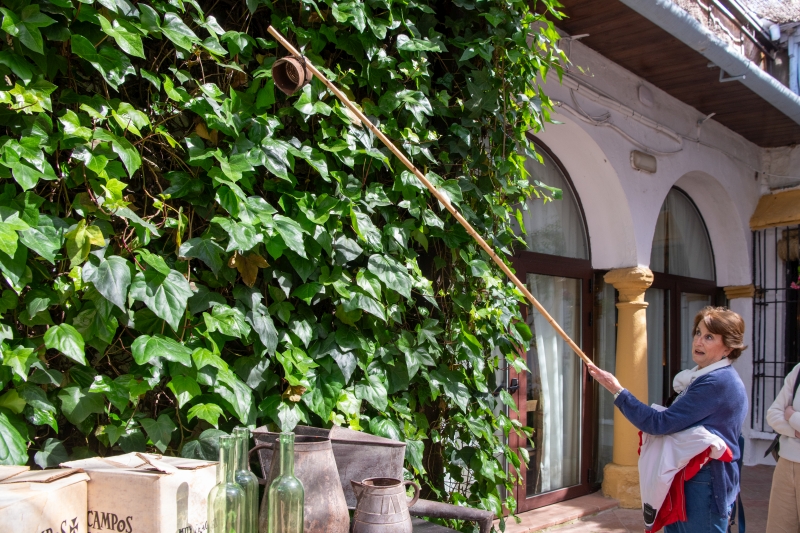
Equipped with sturdy shoes for the extensive walking, patience for the inevitable queues, and plenty of enthusiasm, our group immersed itself in one of Andalucía’s most colourful and atmospheric traditions. We were especially fortunate to be guided by the inimitable Inmaculada Porras Castillo, who expertly steered us around the labyrinthine rutas de patios and ensured we experienced both celebrated favourites and lesser-known gems.
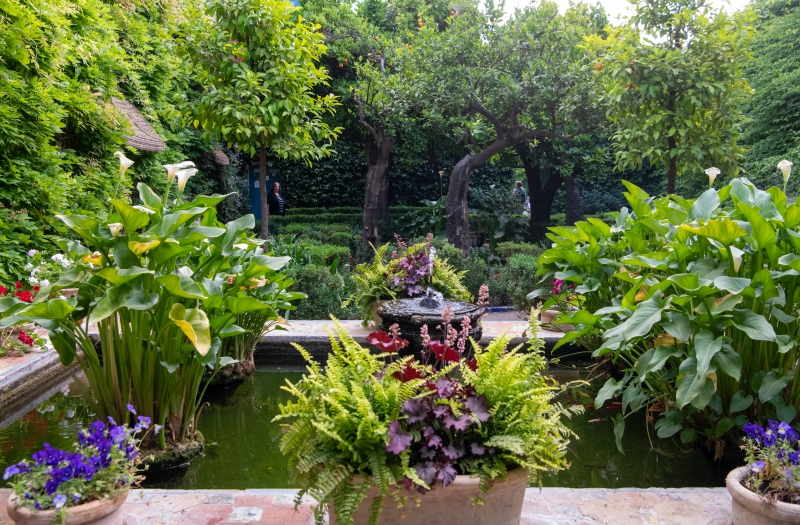
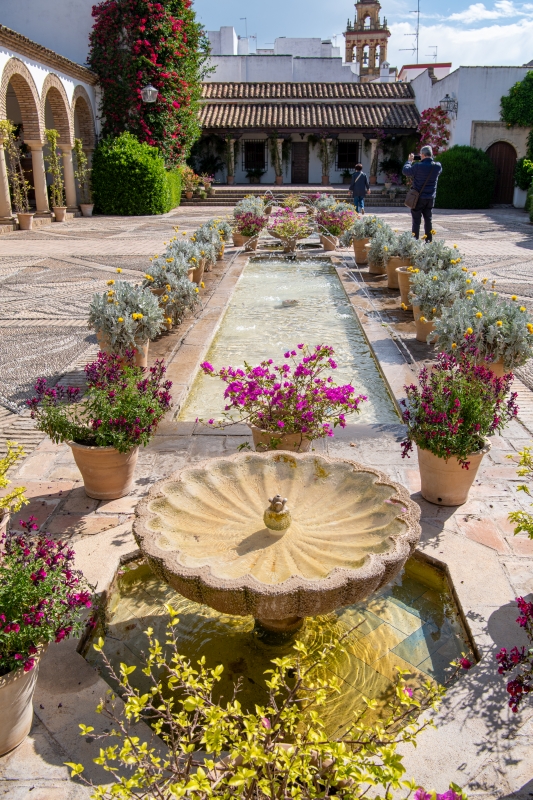
The Patio Festival has its origins in Córdoba’s Roman and Moorish past, when inward-facing homes with central courtyards provided cool, shaded living spaces during the fierce Andalusian summers. Over generations, residents transformed these practical spaces into richly planted sanctuaries filled with flowers, fountains and ceramic pots. Since 1921, Córdoba’s annual patio competition has celebrated this tradition, with patios judged on criteria including architectural harmony, plant quality, creativity, maintenance, traditional character and overall visual impact. The festival was recognised by UNESCO as Intangible Cultural Heritage in 2012.
Several members of our group also attended an evening visit to the magnificent Mosque–Cathedral of Córdoba, finding the softly illuminated interiors especially atmospheric and memorable.
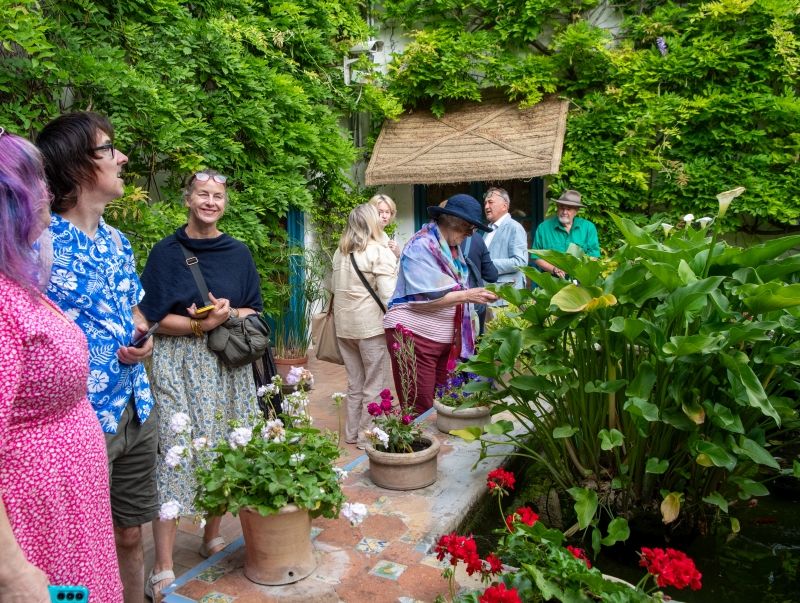
Plant lovers were, of course, in their element throughout the trip. Pelargoniums predominated everywhere, cascading from walls and balconies in extraordinary abundance. Particularly striking were some spectacular double-flowered varieties that resembled azaleas from a distance, creating vivid clouds of pink and crimson.
Among the most talked-about plants was Centaurea de Viana - as the name suggests, originating from the famous Palacio de Viana and traditionally propagated by cuttings that have gradually spread throughout patios across the city. Also widely admired were the vibrant shrimp plants, Justicia brandegeeana, and the stunning fragrant walls of Trachelospermum jasminoides, whose perfume drifted through many of the courtyards.
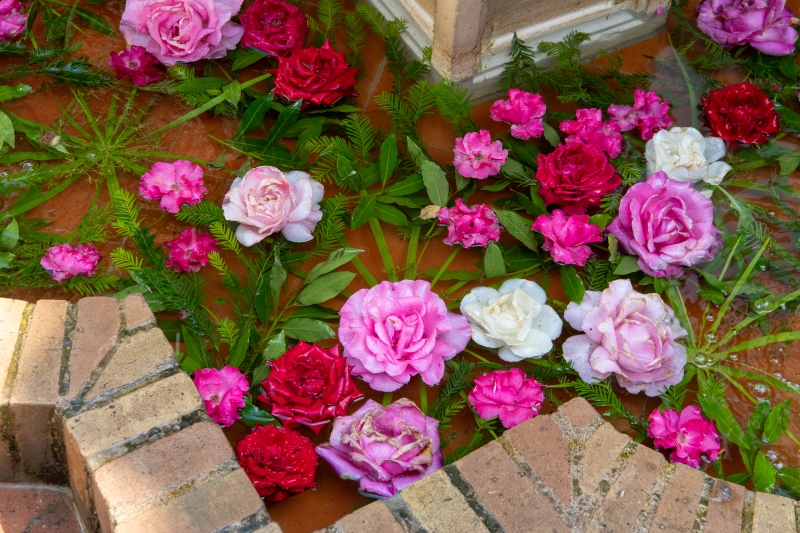
Another unsung hero was Asparagus densiflorus, proving itself tough as nails and perfectly suited to Córdoba’s dry shaded conditions while still providing soft, elegant foliage.
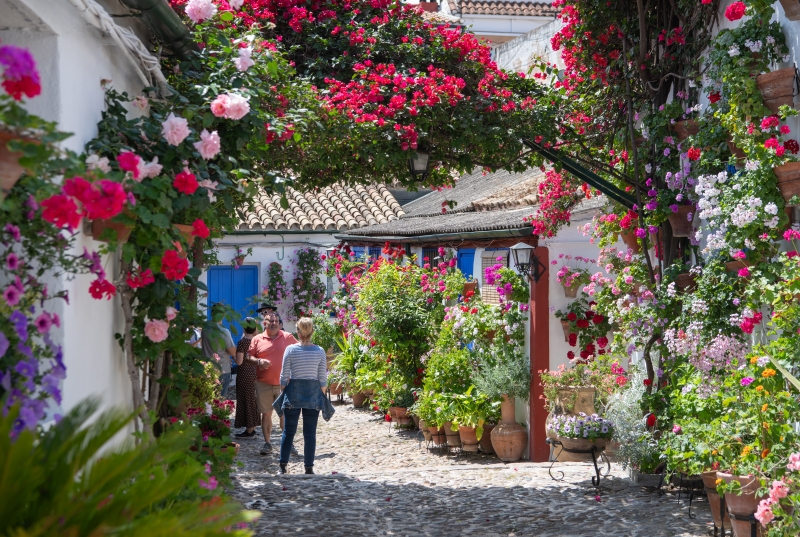
Among our group favourites were the patios at Marroquíes 6 and Martín de Roa 7 and 9, particularly noted for their seemingly impossible floor-to-ceiling displays of brilliant pelargoniums suspended in terracotta pots.
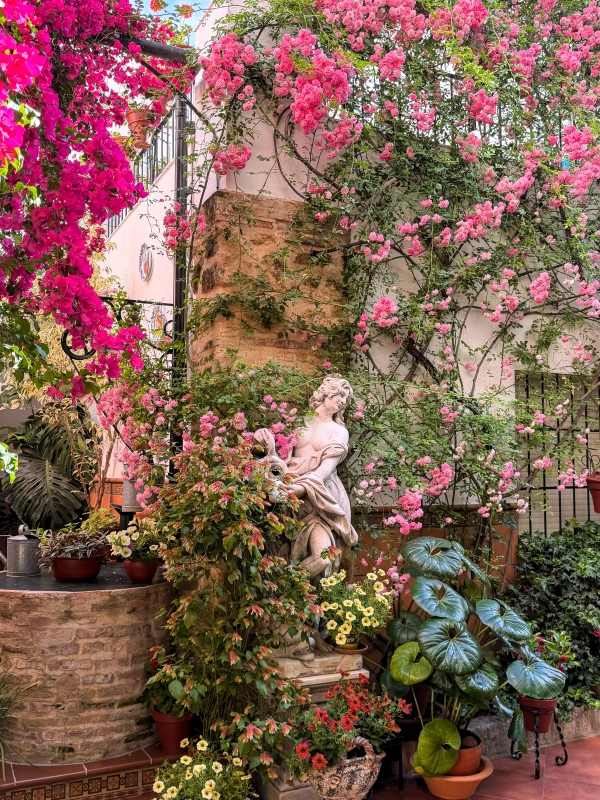
Beyond the patios themselves, the group also visited the historic Palacio de Viana, where many familiar patio plants were displayed on a much grander and more formal scale across its series of courtyards and gardens. We also spent time at the Real Jardín Botánico de Córdoba, where members were particularly fascinated by the collection of petrified plants.
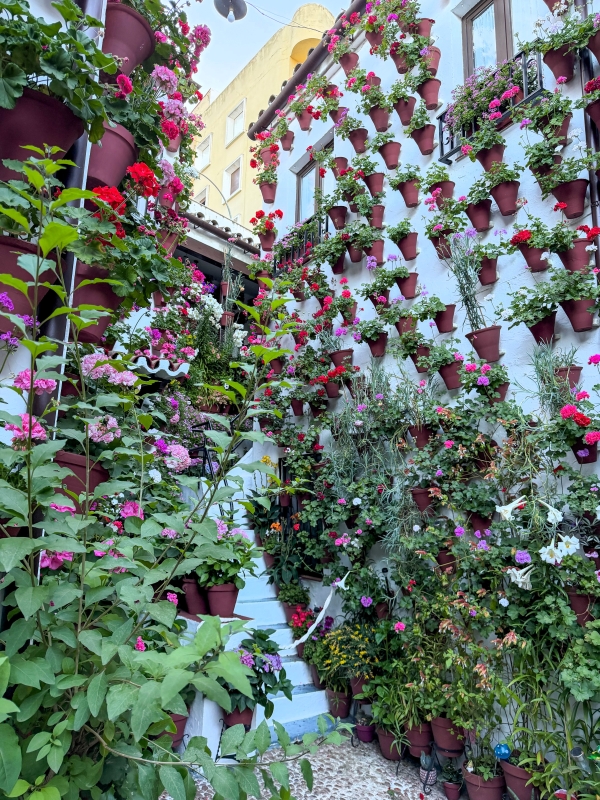
The visit offered inspiration not only in planting combinations and resilient Mediterranean species, but also in the way Córdoba’s residents continue to preserve and celebrate a centuries-old gardening tradition with extraordinary generosity and pride.
January 2026 - Morocco
Garden trip to Tangier
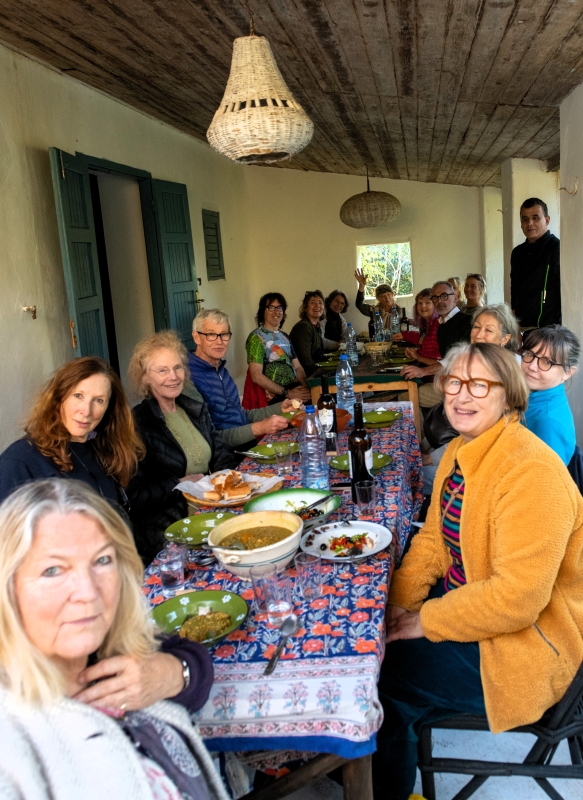
Barely able to contain our excitement, 16 members of the Andalusian Branch of the MGS set sail from Tarifa, Spain, for our spectacular garden trip to Tangier, Morocco.
Our group was led by the ever-enthusiastic and super-efficient botanist Dr Sibylle Mattern (Making a Garden in Andalusia, TMG 115/116), who co-organised what turned out to be a proper tour de force. We were following in the footsteps of a much larger MGS group that visited in 2022. That trip was the brainchild of Italian branch head Angela Dunford. Sibylle and her right-hand, Katrin, a garden designer based in Spain, managed to negotiate visits to all the same incredible places.
I suggest you read the broader write-up of that first MGS visit (Trip to the Gardens of Tangier, September 2022) before diving into our motley group’s reflections on the personalities - both human and botanical - that had most of us clocking up well over 10,000 steps each day through six gardens. To my eternal gratitude, I was travelling with some exceptionally knowledgeable and experienced horticulturalists, so I hung on to their every word. That is, when I wasn’t hanging just as avidly on to the words of the gardeners who led us through their Moroccan pieces of paradise.
So let’s start with the endeavours of two passionate gardening pals, both with the energy and agility of Thomson’s gazelles. One is interior designer Veere Grenney (originally a Kiwi), whose elegant architectural planting is every bit as beautiful as his interiors. The other is his dear friend Umberto Pasti, a fascinating Italian eco-warrior-cum-writer who loves his plants - especially the rescued ones - with the intensity of a devoted orphanage director. Umberto has gardens of his own, but we’ll come to those shortly.
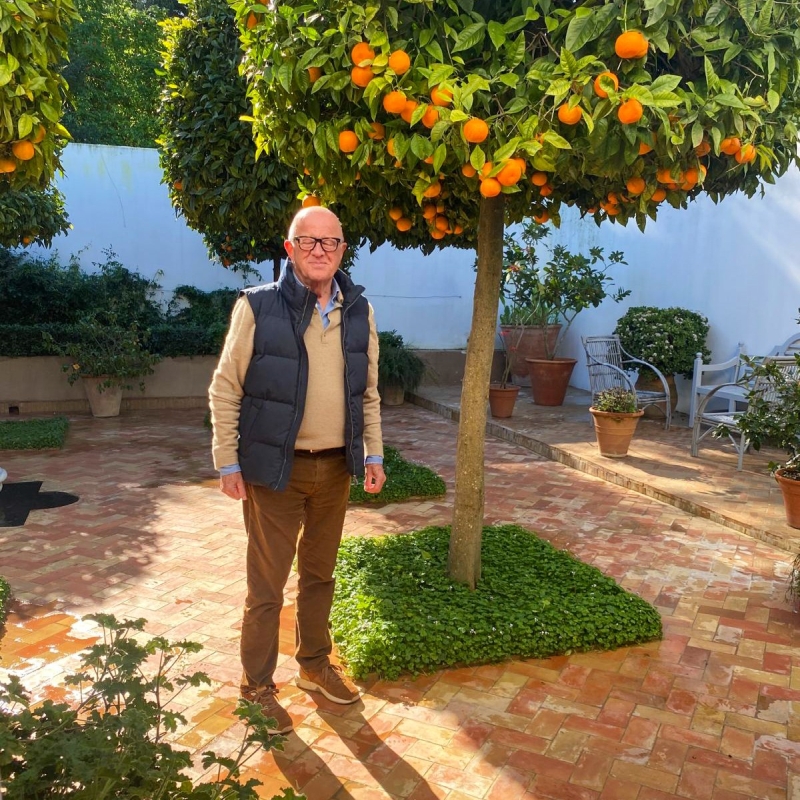
Our visit to Veere’s modern house and just seven-year-old garden, perched on a hill with a view you could quite literally die for, gave us plenty to cluck about. In this lush, beautifully watered green land lay our first three strokes of luck. First, the great man himself was at home. Second, he seemed genuinely delighted to lead us around, fielding questions from members of our random group clutching at his jumper - questions that might have sent a lesser soul sprinting back to one of his other beautiful homes and gardens in the UK. And third, his lovely staff supplied Moroccan biscuits of such excellence that one little greedy gut who will remain nameless managed to scoff at least six. And can you believe they did so whilst drinking mint tea and admiring Veere’s antique collection of enormous olive gathering bowls? These were arranged artistically on the wall of his Sevillian-style ornamental orange tree courtyard. Impressive multi-tasking.
All that biscuit fuel was no doubt required for the relentless walking, photographing and admiring of gorgeously resilient plants like Calandrinia spectabilis (rock purslane, aka Cistanthe), Trixis peruviana (Veere called them winter-flowering Peruvian daisies) and what I thought were Damask roses, but I might yet stand corrected. It’s a tough life.
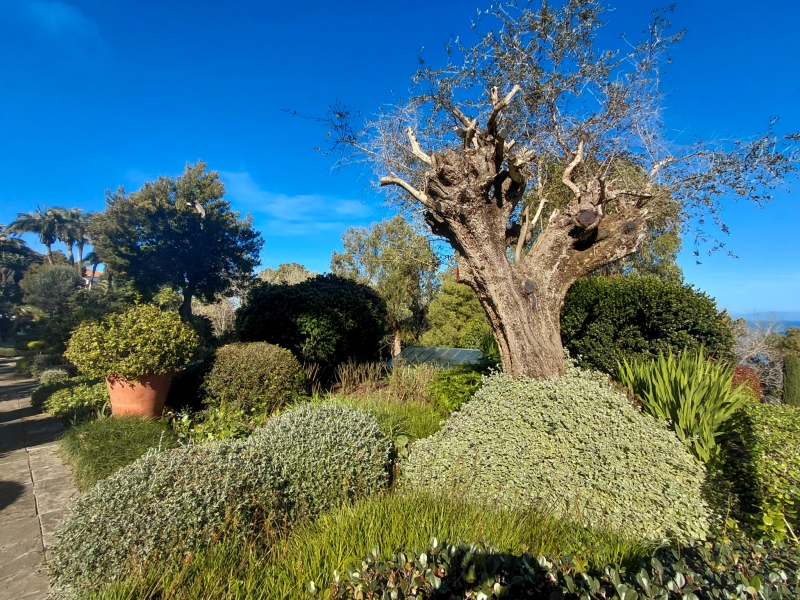
Many of us commented on the simple pleasures. I loved the way Veere’s nasturtiums were trained up bespoke wooden structures rather than taking up squatting rights and sprawling everywhere like they do on my patio. “I could make one of those,” I thought smugly, remembering my Girl Guide days making wooden washing-up stands at camp. We stood for ages admiring how the Teucrium spec. hugged the base of a very contented olive tree. We were all clearly planning to nick that idea. Others finally let go of Veere’s jumper long enough to loiter by the breathtaking pool - and almost certainly regretted not packing their cozzies.
For me, the planting didn’t so much edge the pool as lounge around it: large pots crammed with agave for example teetering at the margins, palms preening nearby, flowers slouching, and succulents standing guard like decorative weapons. There was clearly much beauty worth guarding.
And so to Veere’s pal Umberto, who helped wild-up pockets of Veere’s design when he wasn’t writing books or tending to his own two extraordinary places. At heart he’s both town and country mouse. He has lovingly curated a rainforest type oasis on a city hillside and also Rohuna - less a garden than an estate, with around 5,300 species - on a stony hillside about 50 km south of Tangier.
At his town garden Tebarek Allah, we were lucky enough to have the Orphanage Director himself lead us around, in a repeat performance of the clucking and jumper-clutching we’d perfected at Veere’s. To me it felt like a shaded rehab centre for wayward greenery: everything is saved, nothing listens, and yet it all looks brilliant. Rescued plants mingle like former delinquents at a garden party - some flamboyant, some sulky, all claiming space. I remarked on the lack of places to sit in this mini rainforest wrested from tangles and neglect. Umberto said he was always on the move and hardly ever sat down anyway.
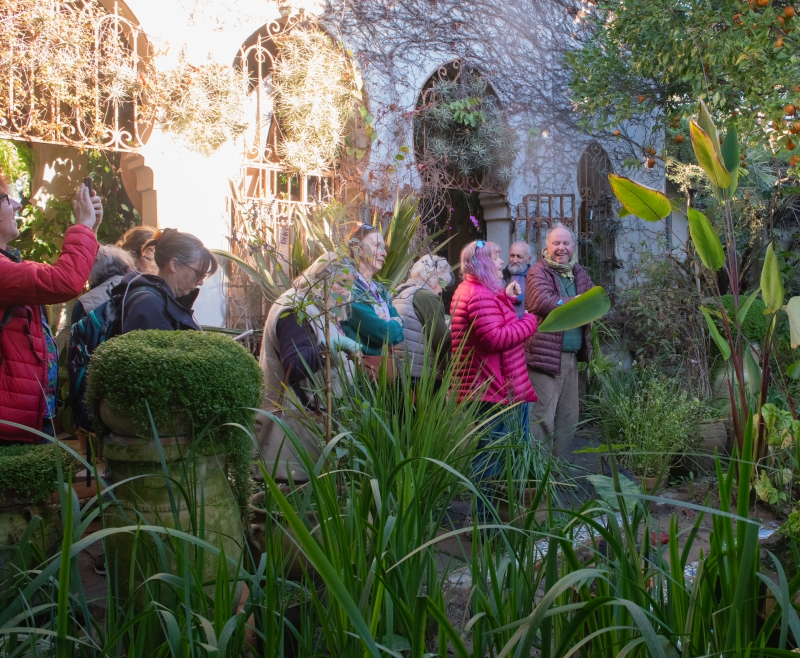
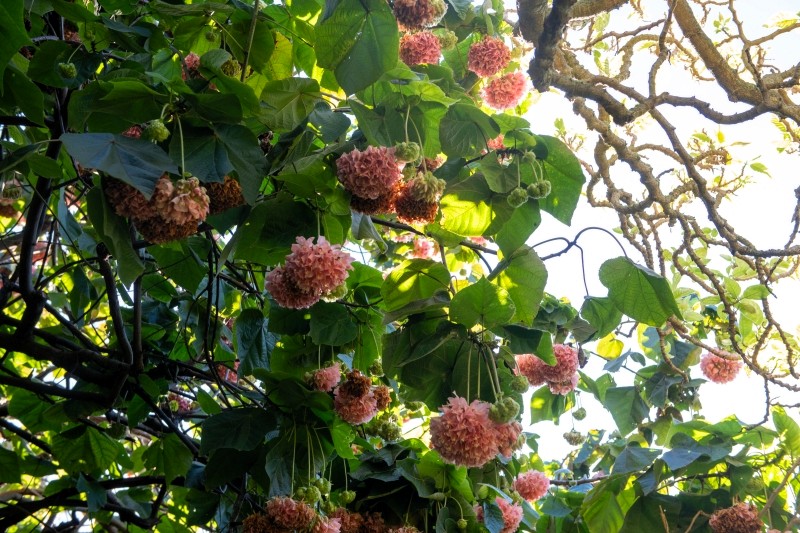
His plants thrive under what seems like fierce, fatherly devotion - adored, nurtured, and occasionally (in the case of his favourite bulbs) slightly spoiled perhaps in the eyes of more neglectful plant parents. His longstanding collaborator, Mohammed, was also showing us round and explaining his own rescue missions and plant-nursing experiments. When Umberto or Mohammed talked about individual plants such as Tagetes lucida - standing close and stroking leaves - I noticed more than a few moist eyes, my own most definitely included. It was comforting to spend time with gardeners who feel as intensely about their plants as many of us do. Somebody openly coveted his Dombeya such that I thought they might dig it up and run off with it. Our trusty leader Sibylle is perhaps right now scouring the internet for more Montanoa species in a bid to recreate a lingering sense of some of Umberto’s successes in her own gorgeous Andalusian garden.
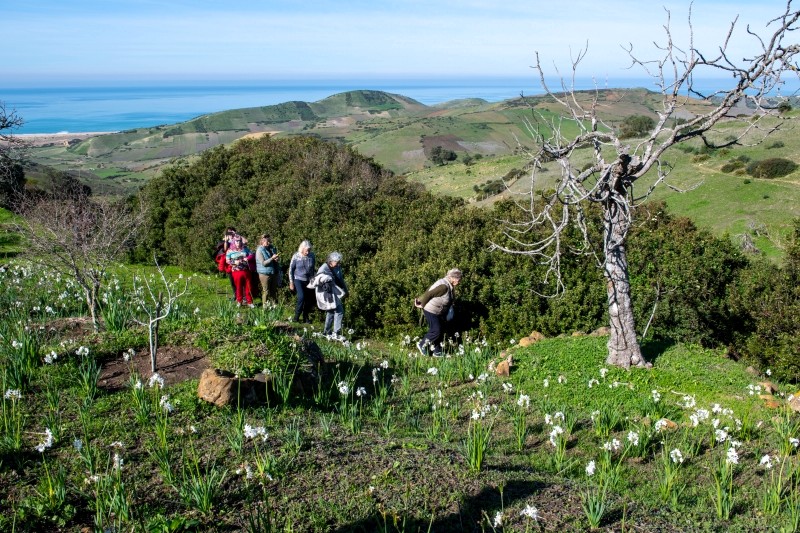
Rohuna, the Rescue Mission where Umberto told us he is happiest, is another hillside paradise, this time in the countryside with sweeping views and on a far larger scale - around 7–8 hectares. Once-barren slopes now burst with native Moroccan plants that Umberto simply refused to let disappear. Terraces, paths and scrappy stone walls corral bulbs, wildflowers, shrubs and trees into a joyful mêlée. Some sprawl, some glare, and a few look as if they’re quietly plotting world domination. Many of us decided that the vast alpine meadow bursting with narcissi and other flowering bulbs was our new nirvana.
Sadly, Umberto couldn’t be there for us to trail adoringly behind him, but his wonderfully proud helpers showed us around, pointing out quirks, dramas and stubborn survivors. They also produced a delicious lunch of salad, lentils and chicken, devoured with some excellent local wine, served on the terrace outside Umberto’s quaint studio where he slept when he was in residence.
Being something of an inspiring do-gooder myself, I loved that a key focus of our trip was charitable support for gardens, buildings and the lovely things that happen in them. Umberto has plenty in his worry bag, as he needs to raise funds to keep his rescue missions going, so please give generously to his foundation if you’re as inspired as we were (How to Support - Garden of Rohuna).
Veere, meanwhile, supports the Moroccan-style St Andrew’s Church and its beautiful garden, which we also visited. Gifted by Sultan Hassan I to Queen Victoria, the church is kept in good shape for Tangier’s Anglican community. There, the lively caretaker Yassine gave us an admiring spiel about some of the famous people buried in the graveyard and pointed out Moorish architectural details I would definitely have missed had I been left to wander alone. Some of us Anglican-schooled Brits were so moved after our church visit that we even started singing a few of our childhood hymns in the gorgeous church garden. Others covered their ears…
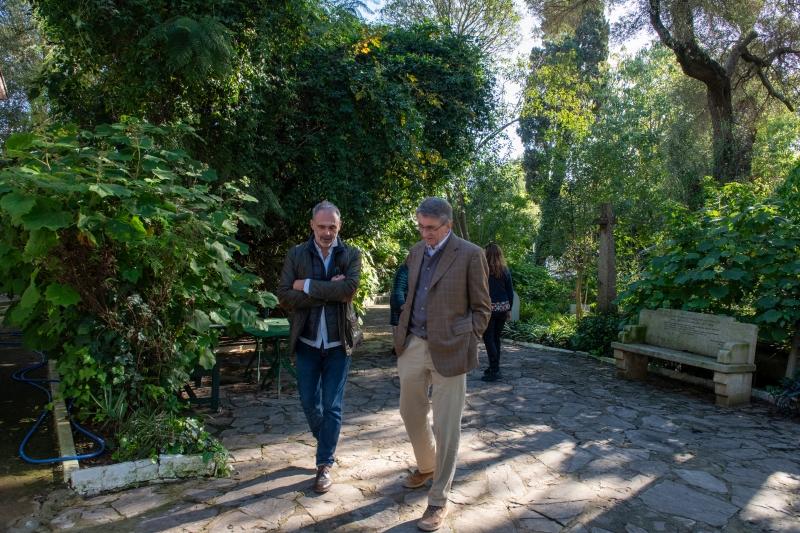
And this brings me to my final bursts of enthusiasm. Shut your eyes and imagine another Tangier garden, this time set in woodland on a hill in a nature reserve. Imagine a botanical garden founded and curated by an intelligent and kindly woman with a serious drive to honour her late father, who shared her passion for environmentalism. Malika El Alaoui inspires loyalty from the gardeners and helpers she gathers around her mission. Imagine sea views from the terrace of her rustically sophisticated café, serving top-notch Moroccan nosh - including a fiery homemade organic harissa that I loved so much my purse took pity on me and felt compelled to buy me a jar. Imagine it all being washed down with healthy homemade juices that make you feel entirely justified in scoffing one of their lovely orange and almond cakes immediately afterwards. Imagine all that and you’ve arrived at Donabo, Tangier’s first public botanical garden.
Donabo is much younger than Umberto’s town rainforest and certainly not as pristine as Veere’s garden. However, it has its own quieter merit, much of which we were able to see for ourselves. I’m thinking now of the abundant kitchen garden, whose crops were turned into plates of loveliness by chefs who shared Malika’s passion for serving healthy, delicious Moroccan grub. Even though, on arrival, some of us were desperate to beetle off down the hill as soon as we heard the word “café”, our tour of the garden with Malika kept us fascinated. The garden is laid out as a series of ten “rooms”, including rose, Chinese, and pollinator gardens. Some of us were especially taken by the mint room, where more than twenty varieties are grown to show off the region’s botanical richness. Others admired the extensive wooden pergolas, which contribute to the garden’s informal, charming, homespun look - ideal for a spot of shade in summer while enjoying one of the yummy ice creams they probably sell in the café, I mused.
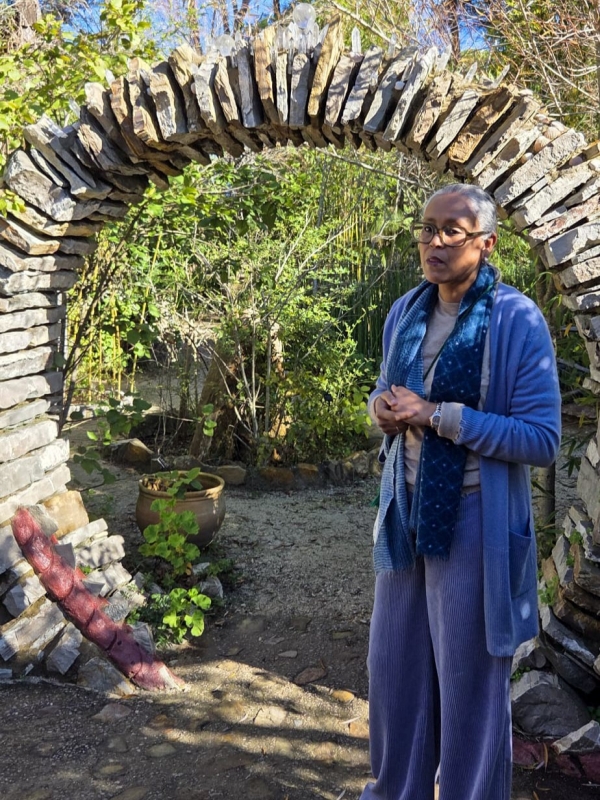
The mint garden became my favourite part of the garden (apart from the café, of course) when Malika explained why they grow chocolate-scented mint: to pique the interest of children. I love the fact that Donabo Gardens is for everyone — not just the people who usually get to places like this. Alongside families and visitors, the garden regularly welcomes children from public schools and community organisations, including those who don’t always have easy access to green space. No big speeches, no spotlight — just the gate opening and kids being kids. Perhaps later on, some of them might even join the MGS. I can easily imagine those junior horticulturalists filling the garden with excited chatter as they rub mint leaves between their fingers, taking a sniff like I did and briefly thinking someone’s left them a bit of chocolate among the foliage. Listening to Malika, it’s obvious that this garden was created by a founder with a deep love of plants and children. She has a quiet belief in doing good and helping people feel good through nature. At Donabo, learning happens naturally: children seeing where food comes from, noticing insects in pollinator plants, touching olive trees, asking questions, and building their own relationship with the living world — before, perhaps, venturing down to the café for a well-earned scoff.
If you’d like to help children who don’t have the same opportunities to learn about plants and develop a love of gardens as many of our children and grandchildren do by hanging out with us in ours, I know a way. Malika would, I’m sure, be grateful for a donation — or you could simply become a member.
Our evening visit to British designer Jasper Conran’s swank pad hotel and garden, Villa Mabrouka, provided a contrasting experience. Most of us couldn’t afford to stay there, but our trusty organisers had managed to swing a wonderful Mabrouka experience for us with the help of Tangier insider and local MGS member Pin Affleck.
Pierre Bergé bought and restored Villa Mabrouka with Yves Saint Laurent in 1997, long after they were no longer romantically involved. Yves admired the work of celebrated American garden designer Madison Cox - and so did Pierre. Madison became the designer behind the restoration of Villa Mabrouka’s extensive gardens, and later Pierre married Madison. All very civilised. The villa was opened by Jasper Conran as a hotel in 2023.
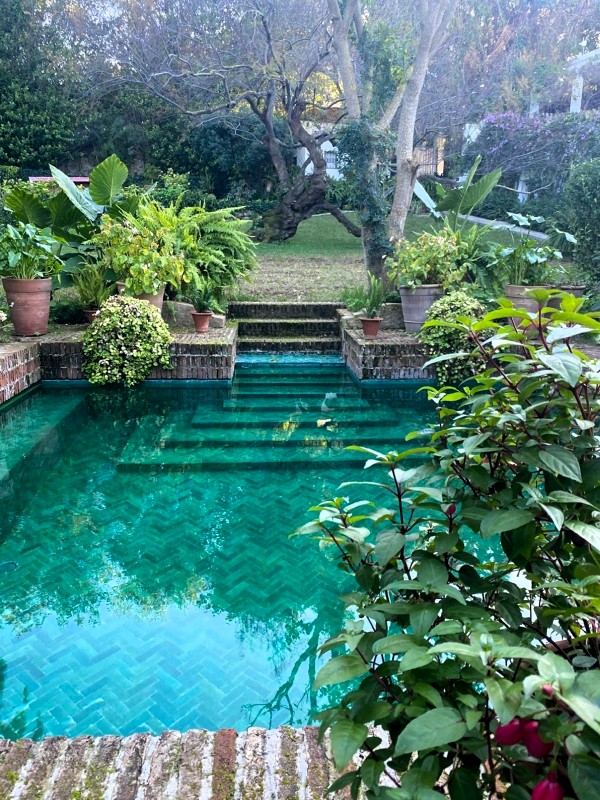
The gardens at Villa Mabrouka feel like being let in on a very glamorous secret. Everything is immaculately manicured - clipped, coaxed, and clearly adored - yet it never feels stiff, more like a well-trained chorus line pretending it just threw itself together. They’ve also maintained Moroccan influences to a tee, both in the house and garden. And oh what a garden. When in flower, citrus trees perfume the air as palms and banana plants sway with casual confidence, while bougainvillea flings itself across walls in unapologetic pinks and purples. Agapanthus dots the terraces in inky blue bursts - though I had to imagine that last bit, as they weren’t in flower when we popped by. Roses and ferns soften the geometry just enough to keep things flirtatious but still ever so proper. The terraces cascade down towards the pool - gleaming, serene, and utterly inviting - each level a perfectly composed scene that feels as deliberate as couture. We even had a sneaky peek into a garden dining gazebo, where hand-painted morning glories and thunbergias made bold, knowing appearances on the walls, as if to say: yes, this garden is styled within an inch of its life, and no, it’s not even slightly sorry. It’s lush, theatrical, and deliciously controlled - a garden that knows exactly how good it looks and fully expects you to notice. I reckon it contains elements of each of the three men responsible for its creation. I’d love to tease out which bit belongs to whom, but in the end it was a joint effort - and let’s face it, some of the best endeavours in life are.
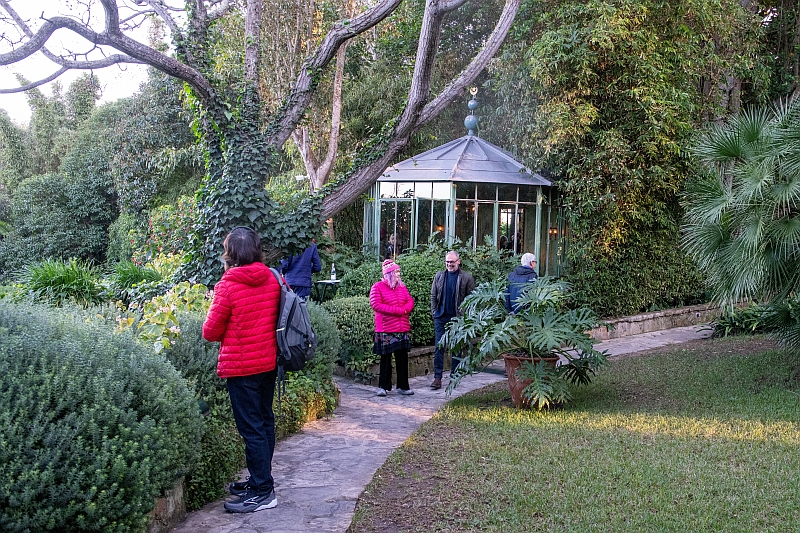
And so I leave you with a final mention of the people behind the female joint effort about which I’ve had the pleasure to write: Sibylle and Katrin - two fabulous women gardeners responsible for many creations, including our wonderful Tangier visit. To them, to my cheery and knowledgeable fellow travellers, and to the makers of some of the most astonishingly beautiful gardens I have ever visited, I say thank you. All of us are still pinching ourselves at the sheer luck of having enjoyed those 5 days in Tangier. We will be back. Possibly even together. Watch this space. I bet you’ll want to come too.
Text: Angie Hart
Photos: Sarah deGraafHunter, Angie Hart, Sibylle Mattern, Samantha von Meister, Sonja Tiscenko
October 2025 - Marbella
A Celebration of Growth: Andalucía Branch Anniversary
Members of the Andalucía Branch of the Mediterranean Garden Society met in Marbella on Saturday to celebrate the anniversary of the refreshed branch. The gathering took place in the beautiful garden of our branch head, Sibylle Mattern, who’s planting perfectly expresses the spirit of Mediterranean gardening - resilient, elegant, and full of seasonal character.
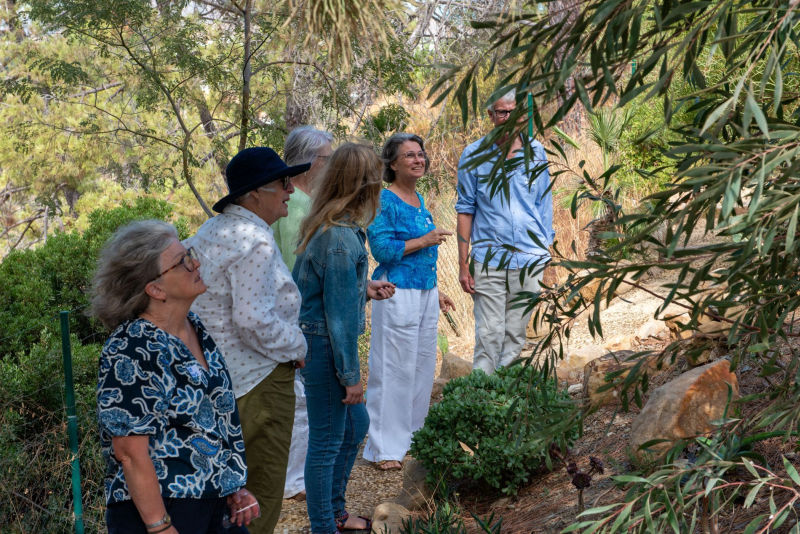
The afternoon was an opportunity to reconnect and to welcome new members, among them six-year-old Dani, whose enthusiasm for plants brought a wonderful energy to the day. We were also pleased to greet visiting members from the South Australian branch, and to share experiences of gardening in similar climates on opposite sides of the world.
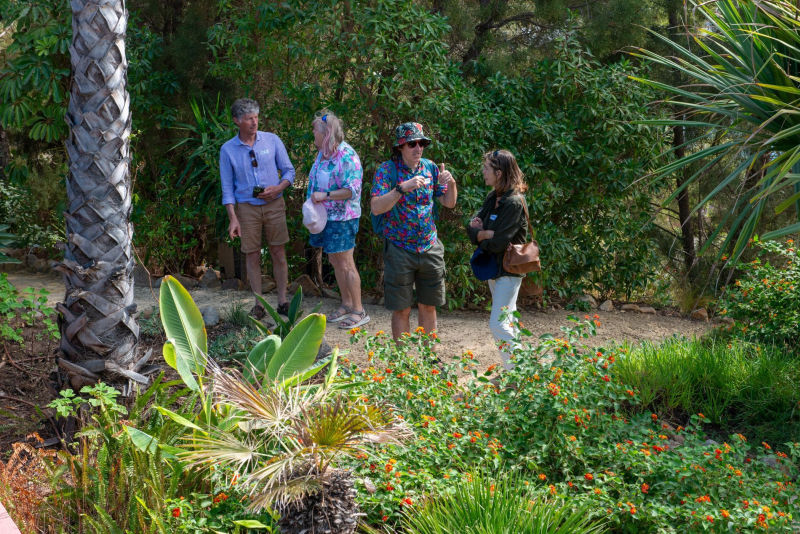
A new element was introduced to our meetings - a plant exchange - which quickly proved a success. Members arrived with pots and cuttings from their own gardens, eager to pass them on and to find new treasures to take home. The exchange table became a lively hub of conversation.
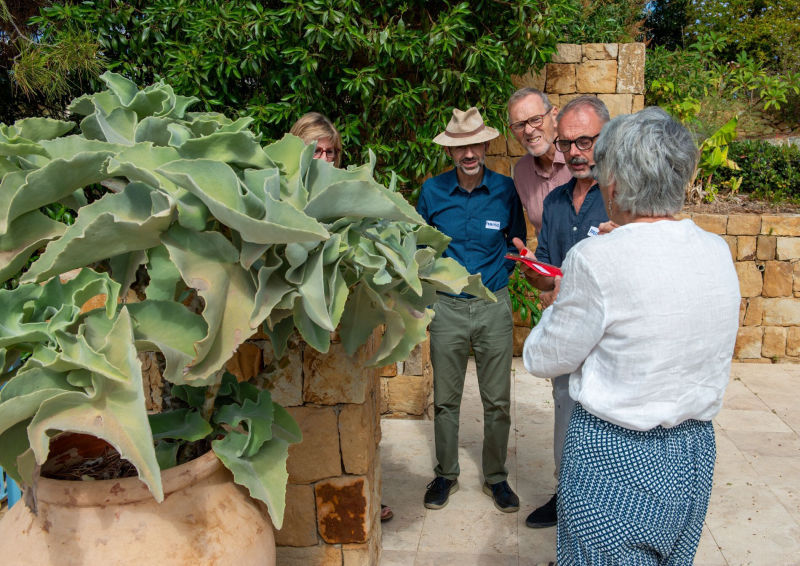
Discussions flowed easily throughout the morning and over lunch, one of the most animated being about the variation in flower colour among plumbagos, and even within individual plants (with the prevailing opinion being that those in the shade hade deeper blues). The recommendation from our collective experience: for the richest blue, choose Plumbago ‘Royal Cape’ (P. auriculata var. Royal Cape).
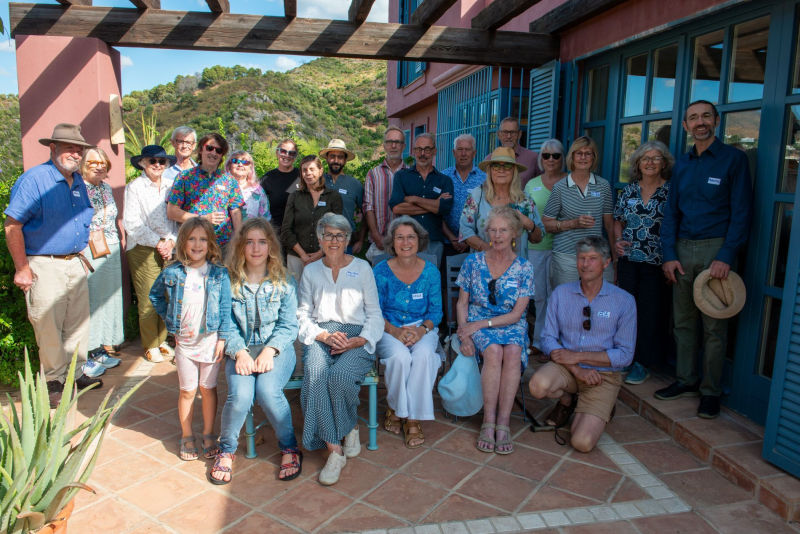
The day reflected everything the MGS stands for: community, curiosity, and the shared joy of gardening in our unique Mediterranean climate.
May 2025 - Malaga
Jardin Del Rosario Revisited
We returned to this spectacular garden for a second time and what a change we experienced!
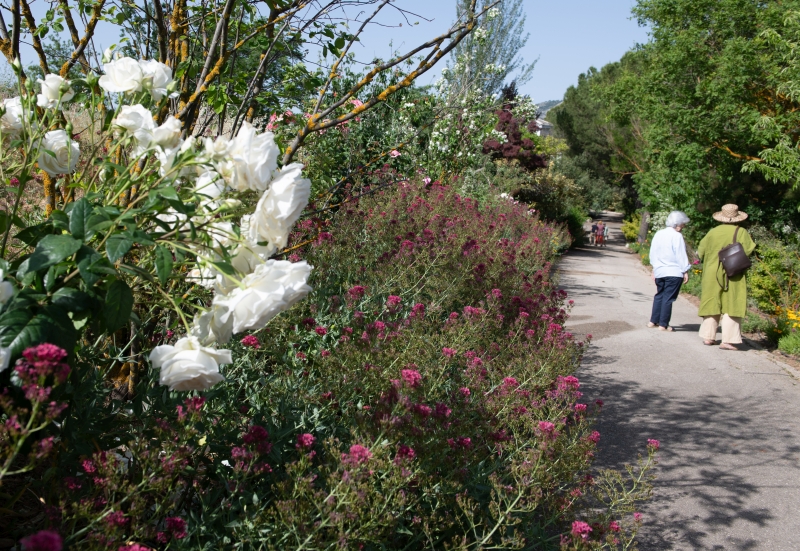
This time we saw the garden in glorious early summer sunshine and with new members - the focus had shifted from autumn colours to a joyful display of roses, coreopsis and cistus.
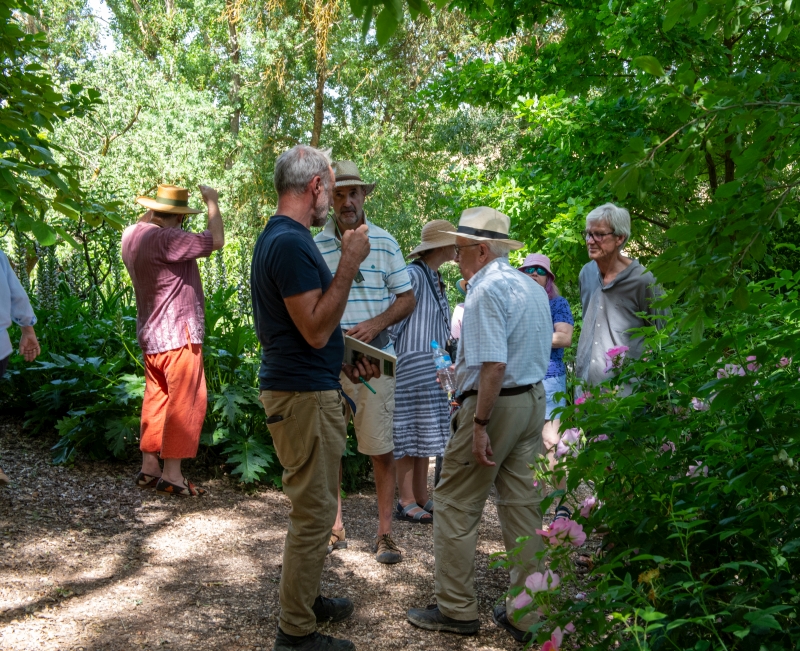
Key varieties that members especially admired were a Cotinus ‘Grace’ in full bloom, the dainty white flowers of Cistus monspeliensis, Rosa rugosa Thunb., Rosa foetida Herrm., Rosa luciae Franch. & Rochebr. ex Crép.
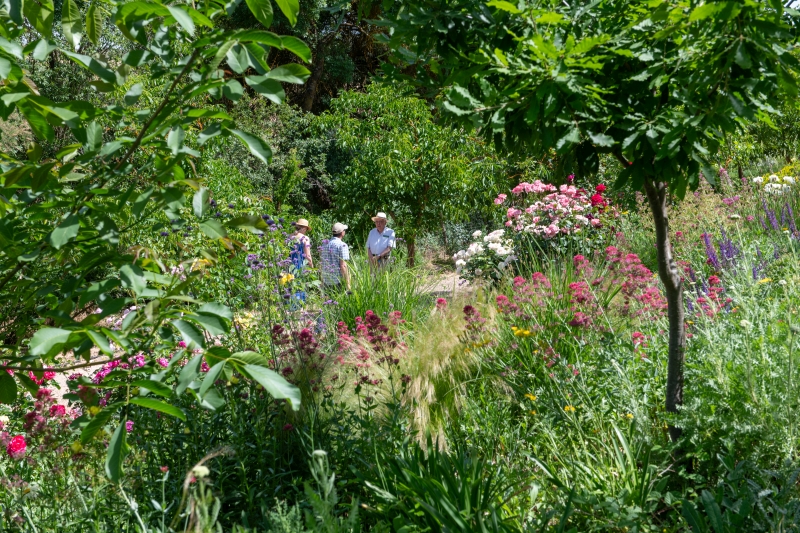
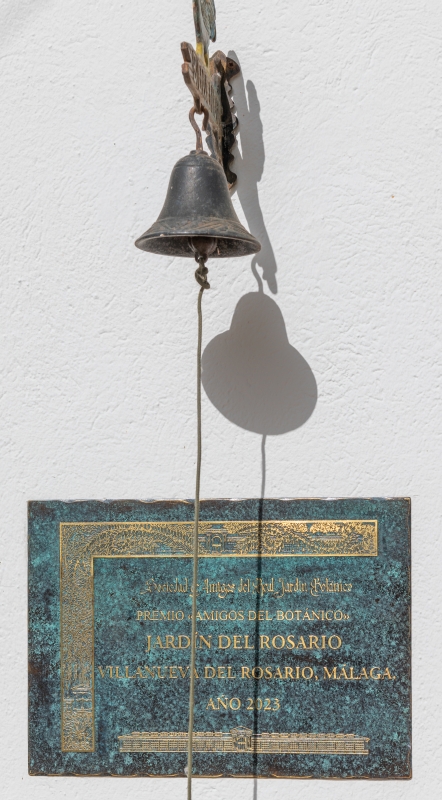
It is no surprise that this garden was granted the “Premio Amigos del Botanico” in 2023 from Malaga´s prestigious botanic garden. It is wonderful to see it change over the seasons.
As always Jose and his family were extremely gracious hosts, and we want to thank them for an unforgettable visit.
April 2025 - Gaucin
Gardeners in the Mist - visit to Richard McCaie´s garden
As many of us followed the winding road up into the clouds of Gaucin we had to trust our GPS and the detailed instructions provided but it was worth it for what was waiting for us. A glorious example of planting full of contrasts, textures, shapes and colours emerged above the clouds among the peaks of the Sierra del Hacho mountain range.

Some of us had come almost 4 hours from Almería (and, before that, Brisbane!) and it was great to welcome new members to one of our events and to discuss how growing conditions vary significantly across Andalucia with challenges associated with only being able to tend a garden some of the year.

With an elevation of 500m, the house was built with a view to protecting it from the prevailing West winds and the garden benefits from slightly milder conditions than in the village at 612m allowing Richard to grow plants like plumeria that would not survive up in the village. However the soil is extremely alkaline and importing soil was vital to establish the garden and support healthy plant growth.
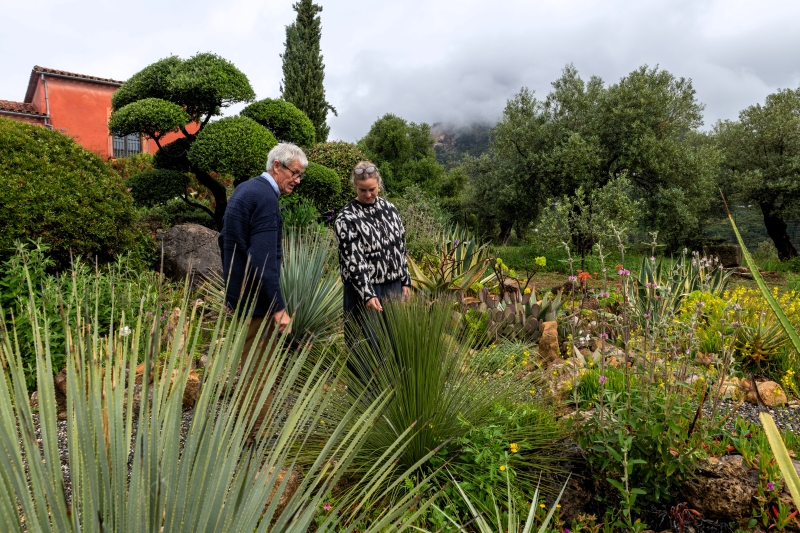
Richard’s garden was a joy to behold and the rains even stopped to allow us to explore the garden. Key to the structure of the garden were the pruned wild olive trees whose soft curves mirrored the tree tops further down in the valley and created a harmonious rhythm to the garden which was ebullient cottage garden style with contrasting colour and form.

The structure of the garden encourages a sense of discovery. The winding pathways meant that you don´t see the whole space in one go (apart perhaps from the porch above the garden) and you feel that you are exploring multiple new areas of around 5 by 10 metres. Shrubs of 2 metres tall eg the pruned wild olives (Olea oleaster, acebuche), Bottlebrushes (Callistemon citrinus), Pistacia lentiscus (mastic) have been used to great effect to block the view from one area to another.

Many of us who usually favour shrubs and waterwise gardening, came away with a resolution to incorporate more bulbs in our planting as these were a striking feature to the garden –favourites were anemones, Babiana stricta, Watsonia borbonica and fresias that had self seeded and hybridised. Impressively, especially to those of us who are still getting to grips with keeping seedlings alive, Richard has grown many of his plants and bulbs from seed. Richard was rightly particularly proud of the Paeonia broteri which he has grown from seed collected from the mountain behind the house.

Other plants that we added to our wish list were: Aloe plicatilis aka kumara plicatilis or the fan-aloe, Agave stricta Sam Dyck, Streptosolen jamesonii and Dasylirion longissimum.

Finally and as always, there was keen interest in the ‘back of house’ working parts of the garden with lively discussions over the challenges of automatic irrigation and compost - a couple of approaches were to break vegetation down in a lidded rollable tub before adding to an open pile or to just add waste into the borders hidden under the plants let it break down in situ.

A huge thanks to Richard and Charlotte for the wonderful hosting and all the advice. It was a day to remember for many of us.
March 2025 - Málaga
Visit to Jardín Botánico - Histórico La Concepción
As a change from visiting member gardens, we chose to explore a historic public garden - Jardín Botánico - Histórico La Concepción. This garden was initially a private garden created in 1855, with more than fifty thousand plants, three thousand tropical, subtropical, autochthonous, endemic and agricultural species, varieties and cultivars. Happily for us, it was turned over to the public 30 years ago and we are able to enjoy it now.

The purpose of the visit was to see the wisteria avenue in bloom however record breaking levels of rain in Andalucia (and most of Spain) meant that the visit was delayed by weeks. Quite apart from it risking being a soggy visit, the flowering was also delayed. So we were a little anxious arriving in case the much-awaited sight would not be on show. Luckily, after four weeks of rain, we were rewarded with a rain of wisteria blooms.

Built by the Heredia family, the arbour is one of the most beautiful iron pergolas to be found anywhere in Spain, twelve roots of Wisteria sinensis originally planted by the Loring-Heredia family back in 1857 now climb over the surrounding ficuses and palms up to heights of almost 20 metres. Its gentle aroma and bunches of lilac flowers create a magical atmosphere.

We were guided around the historic, mainly shaded part of the garden by the wonderfully knowledgeable Javier who especially highlighted the historic elements that we might have missed in favour of admiring the planting. Among particular favourites were La Exedra - a whispering bench where, at one end of the curved bench, you can hear secrets whispered at the other end.

Beyond the wonders of the wisteria, further natural highlights were a sea of clivia surrounding an area where, historically, the young members of the family would put on shows in the 19th Century, some prolific ficus trees (Ficus marcophylla), an avenue of shade giving plane trees (Platanus orientalis ) curving over the pathway and an impressive grove of bamboos.

While we only saw a part of the garden we loved the really tranquil and shaded atmosphere which must have been a balm for the original owners who mainly lived there in summers and winters. A huge thank you to Jose Alba for organising it and his son (also Jose!) for being our host on this visit.

January 2025 - Alhaurín El Grande
Visit to Andrew Sloan’s garden
With reducing water levels and droughts that are familiar to most members of the Mediterranean Garden Society, many of us are not only looking to find sustainable ways to garden but are also investigating changing the plants that we choose to garden with.

This is a trend that Andrew Sloan identified and adopted perhaps ahead of the curve over 10 years ago. Having built a more traditional, irrigated garden in Alhaurin el Grande, nestled in a valley behind Malaga in Andalucia with irrigation when he first moved in almost 30 years ago, he made a radical change and switched the irrigation off in 2011. Once almost all the plants had died on his terraced raised beds, he started out all over again.
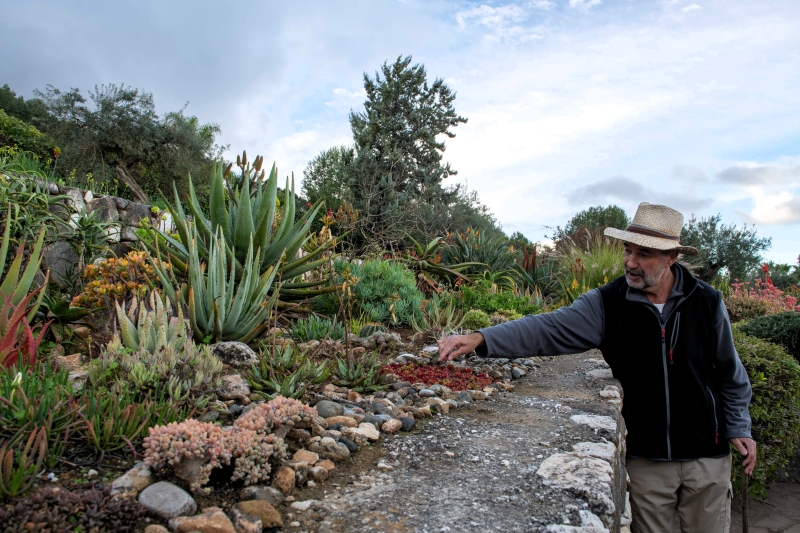
The first point of call was bringing in and mixing in sand to improve drainage (from the existing clay) to create a habitat more suited a totally waterwise garden. This intervention has paid off in spades (forgive the pun) - not only reducing the twice weekly task of watering to once every 3 weeks but also by creating a stunning garden full of colour and contrasts.
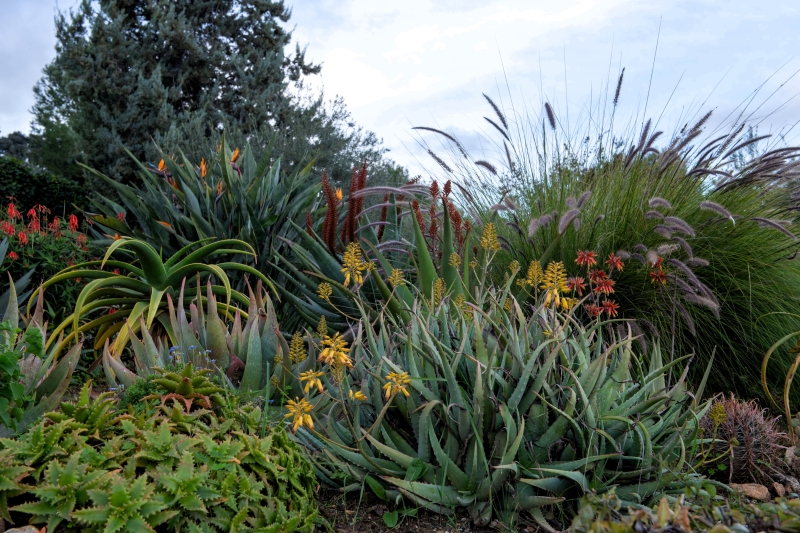
While the garden has many interesting succulents, agave and cacti, for example Kalanchoe fedtschenkoi, Sedum nussbaumerianum, Agave victoriae-reginae, the Aloes were firmly the stars and we were lucky enough to visit as they were blooming.
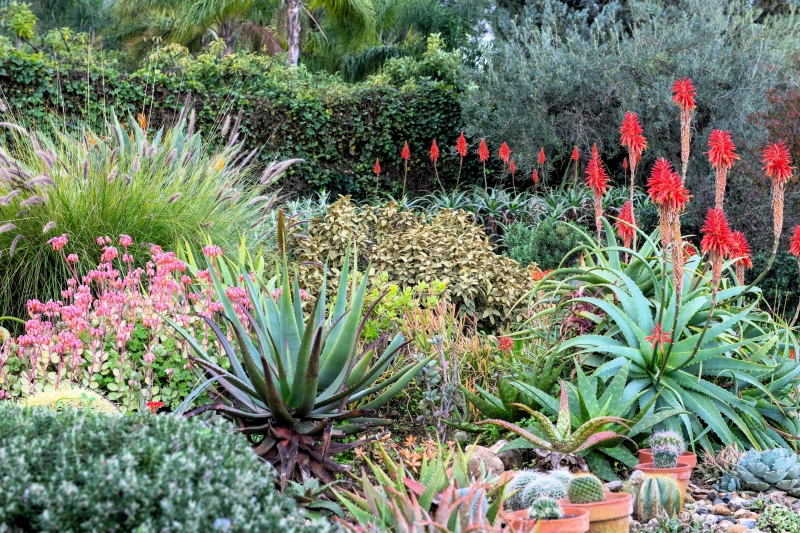
Long flowering (up to 6 weeks) and, unlike agave, they do not die once they have flowered. Some specimens come from far and wide – perhaps most notably Aloe debrana a rare variety from Ethiopia and Aloe dorathea from Tanzania.
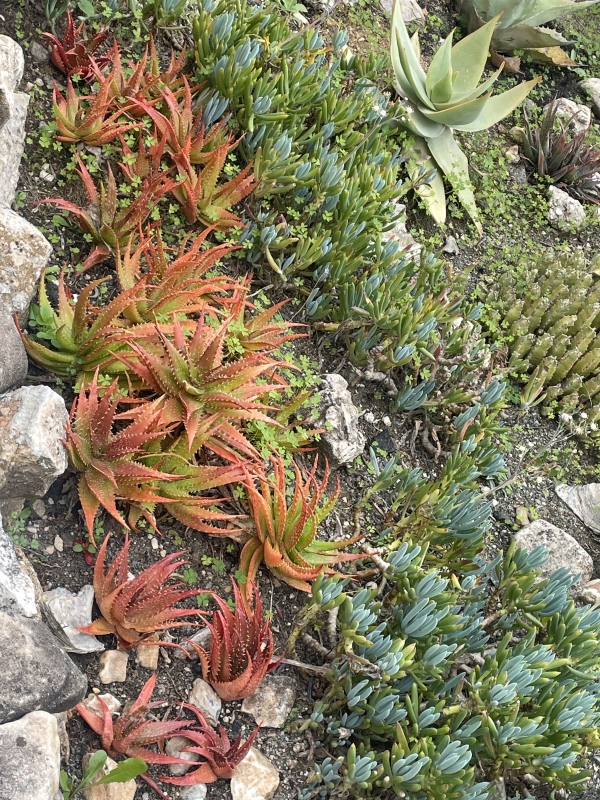
Many of the stronger reds and orange leaf colours that were on show were as a result of water stress – Andrew treads a fine line between treating them mean to create the sunset glows and caring for them enough so that they survive – too much water encourages greener foliage.
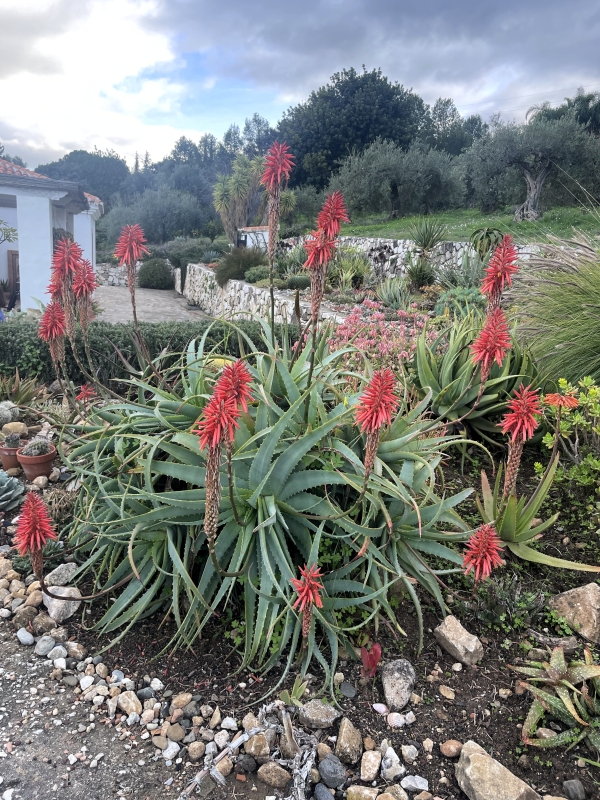
The passion for plants shone through the whole visit and it is no wonder that Andrew welcomes many groups into his garden regularly to introduce them to the joys of aloes. He freely shares his knowledge of propagation and growing from seed – many of which have come from trips with the MGS.
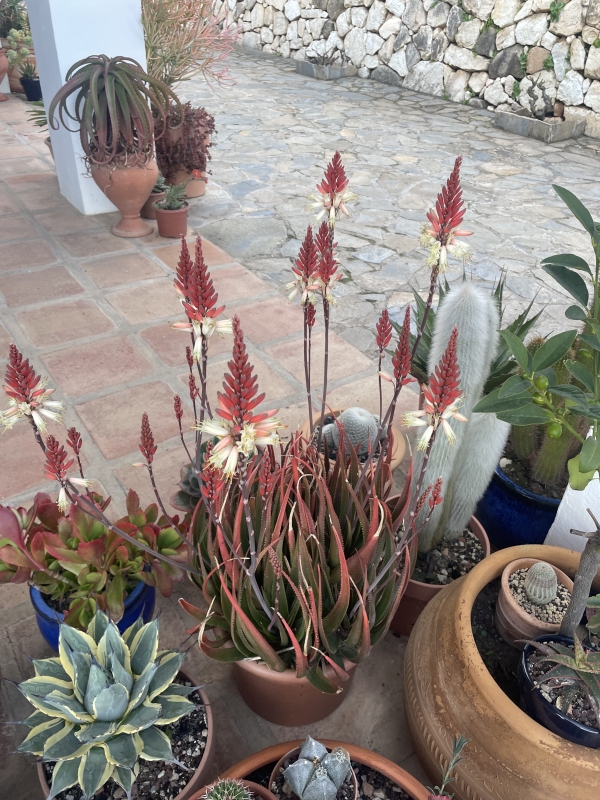
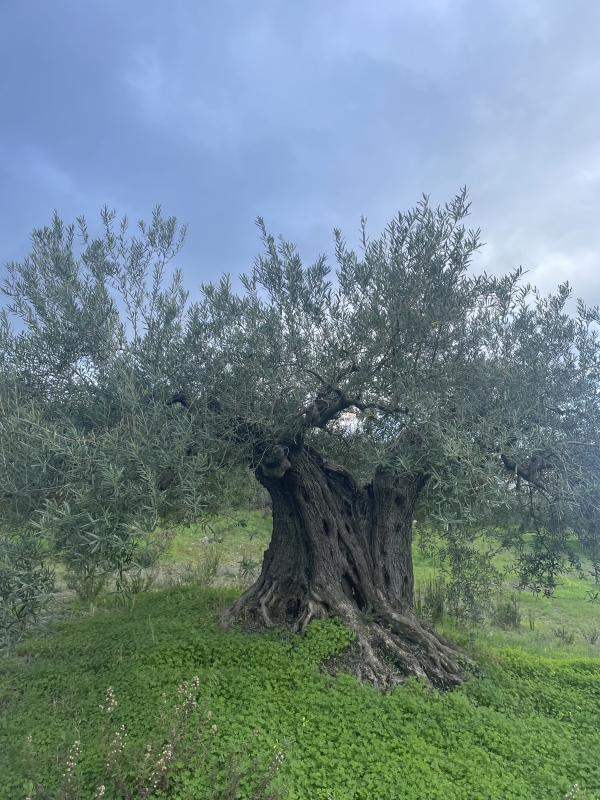
Beyond aloes, we also were able to walk through a wonderful olive grove with trees topping 800 years old that still produce hand harvested crops for oil. This grove includes a fascinating oddity – essentially two ancient trees grafted many centuries ago to create one magnificent specimen - one of which is thought to belong to the times when the Moors ruled Andalucia (between the 8th and 15th Century).
A further experimental approach to exploring all aspects of gardening was also evident in Andrew´s adoption of cultivating in line with the lunar calendar – an approach initially tested as part of a 10 year experiment by Rudolf Steiner in 1925. This approach guides the timing for all activities within the garden – pruning when the moon is waning and planting especially root plants when the moon is waxing or growing. He even extends this to deciding when to have his hair cut!
The visit was a wonderful and thought provoking experience for those who were lucky enough to attend and most went away with a new understanding and appreciation for aloes – and a resolution to incorporate more of them into our own gardens. Who knows, some of us may also be testing out lunar gardening as well.
Text by Katrin Schlenzka, photos by Sibylle Mattern and Katrin Schlenzka
November 2024 - Malaga
Pepe visit
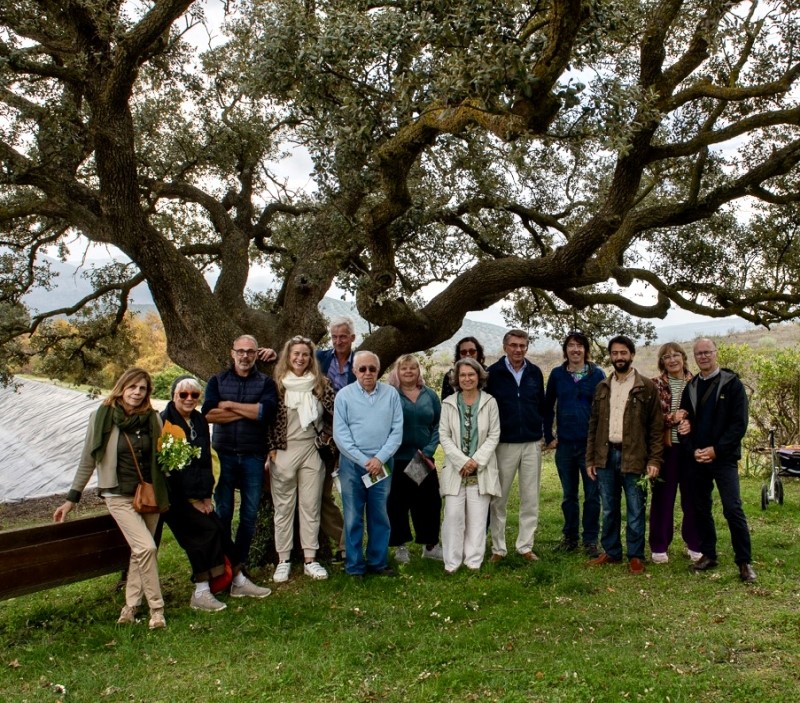
The day we visited the Jardin del Rosario was full of mists and mellow fruitfulness as the Keats poem says and it felt like we were transported to an arboretum in the UK. Yet here was this magnificent estate about 45 minutes from Malaga and around 700m above sea level. At this time of the year (beginning of November) the trees were naturally the stars - though with about 22,000 different plants from around 5,000 species and varieties there is something to appreciate at all times of the year.
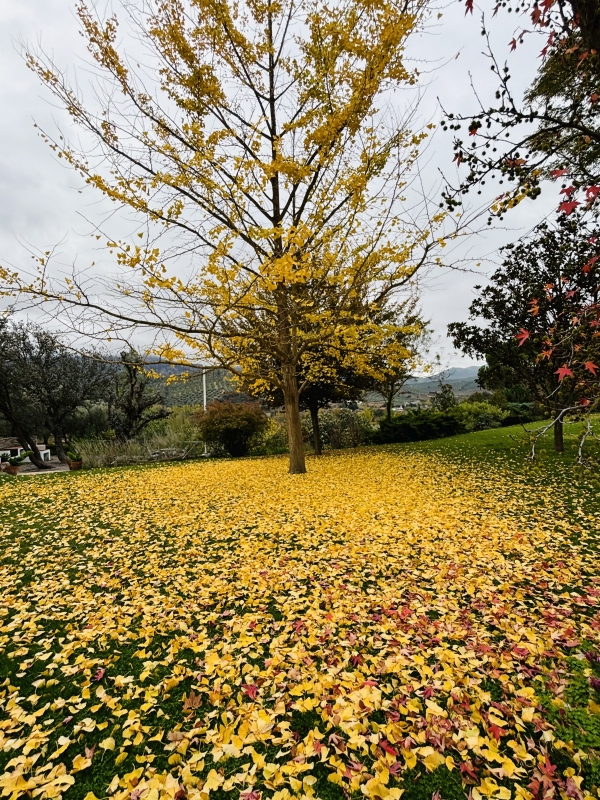
The garden (there was some lively debate over lunch about if it was a park, a garden or an estate!) was clearly created by a passionate and knowledgeable plant collector, Jose Alba Garcia who combines the creativity and sensibility of the artist with the rigour and methods of a scientist. It is hard to think that this garden, with all its sense of heritage and permanence, didn´t exist 40 years ago. Jose´s passion and knowledge shone through during what was, in fact, a short walk but that was extended as we lingered and heard the story behind many of the amazing specimens in the garden.
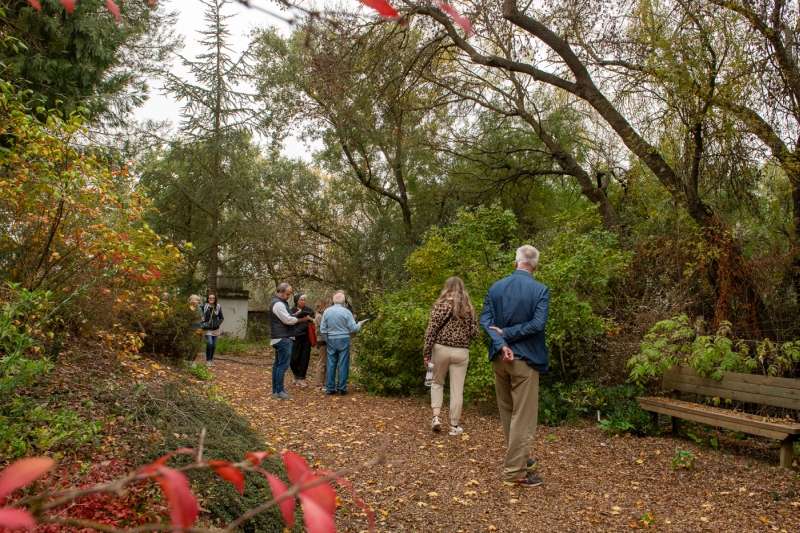
We also saw the scientific side of the project in the form of the groundbreaking approach to plant classification and location that was inspired by his engineering expertise - with many thanks to his son Alfonso who patiently accompanied us with the tablet identifying plants as we excitedly encountered new varieties.
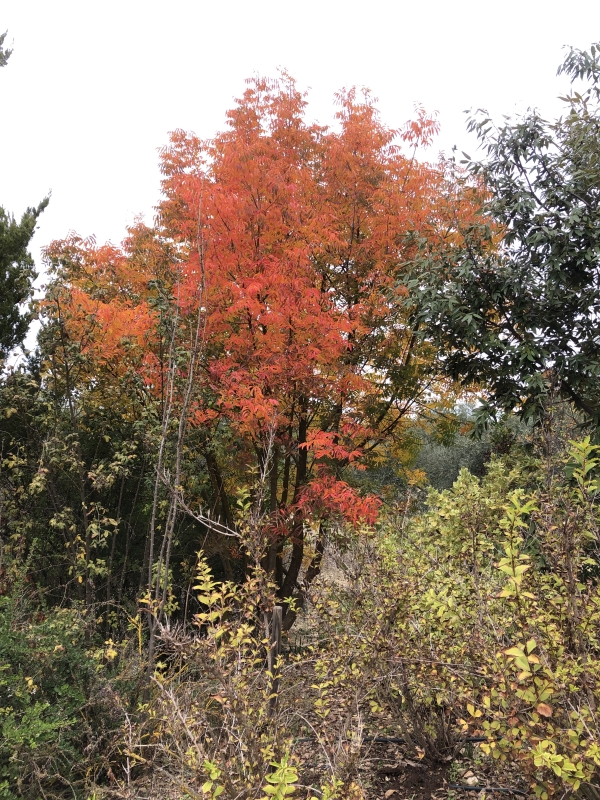
The whole visit was totally inspiring - even for those of use with more modest plots – I think we all came away with a favourite tree to fit into our existing gardens! Some stand out plants that members loved were the Cercis canadensis forest pansy, Celtis occidentalis and the Ginkgo was stunning in all its autumn foliage.
We would like to extend our thanks to our very gracious hosts who gave is an incredibly warm welcome, plenty to think about and a wonderful lunch!
Text by Katrin Schlenzka
September 2024
First Visit of the Branch of the Mediterranean Garden Society
On a windy and hot day twelve members of the newly revived Andalucían branch of the Mediterranean Garden Society gathered at the home of our branch head, Sibylle Mattern, whose garden she vividly describes in issues TMG 115
and TMG 116 of the journal.
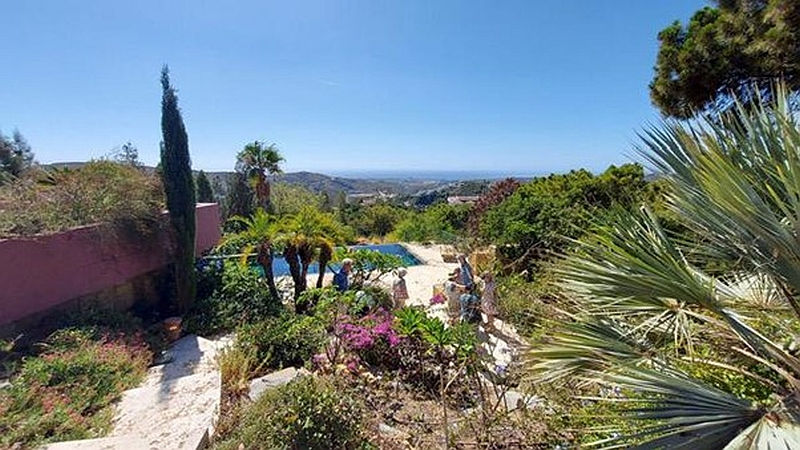
True followers of dry-gardening know that the end of a hot summer is a good time to see a garden for a learning experience. Every garden looks good in springtime, but at the end of a harsh summer? Furthermore, this is our third year of drought here, and added to this, Sibylle’s garden, being on a hilltop, is exposed to wind from every direction. Her garden is cleverly designed to include protective pockets of shelter and shade, while still celebrating the wonderful 360 degree vista. In addition, Sibylle had ceased watering in some areas so we could see the true survival capabilities of some plants.
As to be expected there was some ‘plant envy’ as well, when some interesting plants from Australia and South Africa catching our attention. I was particularly attracted by the look and tactile feel of Calothamnus quadrifidus, commonly known as the one-sided bottle brush, from Western Australia.

Sibylle, her husband Frank and garden designer Paul Neaum, were gracious hosts as we explored the garden and then shared lunch. Friendships were rekindled as some members knew each other from meetings arranged by Lindsay Blyth some years ago. There were also some members for whom this was their first meeting, as well as four ‘garden assistants’ as long-suffering partners described themselves. The gardening knowledge ranged from expert level to those who are novices in mediterranean gardening. The sharing of knowledge was generous; we all left with new ideas for our own gardens. Our next meeting will be held in another member’s garden during, where we hope to see more members; accompanying ‘garden assistants’ also welcome!
Text: Sonja Tiscenko, photos @ThomasSchlenzka

Sibylle Mattern
Sibylle joined the MGS with the aim to minimize mistakes after having started to create her own Mediterranean garden on the Costa del Sol, Spain. She is a biologist (molecular genetics) by training but has been gardening in Germany since her childhood. When she is not in her German or Spanish gardens, she spends her free time looking after her breeding horses or travelling for wildlife
photography.
THE MEDITERRANEAN GARDEN is the registered trademark of The Mediterranean Garden Society in the European Union, Australia, and the United States of America